

Protecting the Integrity of the Game: Enforcement, Prevention & Treatment
The integrity of competition is non-negotiable. The recent NBA betting scandal reminds us that when insider information, game manipulation, and gambling converge, trust in the sport collapses. Once that trust erodes, so does the credibility of the league, the athletes, and the fan experience itself. At Fallston Group, we see this not just as a sports issue, but as an institutional one. Gambling risks extend far beyond individuals placing bets — they test the resilience of entire organizations. That’s why leadership must own both prevention and response. The system must be designed to detect, investigate, and enforce consequences swiftly and transparently. Prevention begins with culture. Policies on paper mean little without education, accountability, and awareness. Every player, coach, and staff member should understand how gambling risk manifests — from subtle conversations about injuries to outright solicitation for insider information. Building an integrity-first mindset takes ongoing training, honest dialogue, and leadership that models ethical behavior daily. Treatment — in this context — isn’t just about punishment. It’s about rehabilitation, support, and restoring faith in the system. When missteps occur, the goal must be to rebuild both the individual and the institution’s credibility. The legalization and normalization of sports betting mean that organizations must adapt faster than ever. Proactive risk management, clear communication, and unwavering enforcement aren’t optional — they’re essential. Ultimately, fairness, transparency, and legitimacy are the lifeblood of competition. Fans deserve to know the game they love isn’t compromised. As I shared on FOX 45 Baltimore, it’s our collective responsibility to protect that integrity — through strong enforcement, thoughtful prevention, and meaningful treatment. Because without integrity, there is no game.
Crisis Leadership: The Hidden Catalyst for Growth
It may seem counterintuitive, but crisis is not the enemy of progress—it’s often the spark that fuels it. In a world driven by relentless competition, digital disruption, and changing consumer expectations, crisis is not only inevitable—it’s essential. The real question leaders must ask is not if crisis will strike, but when. And more importantly: are you ready to meet the moment? Well-built organizations don’t just endure crisis—they invite it. They understand that when disruption hits, it reveals character, clarity, and competitive advantage. According to PwC’s 2023 Global Crisis Survey, 96% of organizations experienced at least one crisis in the past two years. Yet nearly 70% of those who were well-prepared emerged stronger. Crisis whittles down the marketplace—removing the fragile and reaffirming the future-ready. Darwinism is alive and well in today’s digitized world. Organizations either adapt—or disappear. But readiness doesn’t happen by accident. Leaders must treat crisis readiness as a core strategic investment—not an afterthought. This begins with a comprehensive reputational risk assessment to identify the threats that could compromise your brand, operations, and long-term viability. From there, organizations must build customized crisis plans—not templated checklists, but living, breathing playbooks that reflect your values, people, and culture. And most critically: you must train – how you practice is how you will play under duress. You must pressure test these plans under simulated, real-world conditions. Just like elite athletes or military teams, crisis-ready organizations drill until muscle memory kicks in. Because when the pressure is on, you don’t rise to the occasion—you fall to the level of your training. Fallston Group helps you achieve the organizational memory needed to turn short-term adversity into long-term advantage. Not being prepared in this day and age is utterly unacceptable as anyone with an internet connection and recording device can wreak havoc on your brand. Crisis is not a pitfall. It’s a proving ground. A growth strategy in disguise. The question is not whether crisis will find you—it’s whether you’ll be ready to lead when it does. Those who plan, train, and act decisively don’t just survive—they set the new standard for excellence. Remember, reputation leads to trust, and trust leads to valuation. And not all currency is financial. Invest in your readiness now to ultimately preserve your time, money, consumer confidence and career. Your reputation and your future depends on it.
Crisis Leadership in the Spotlight: Rob Weinhold Reflects on the 150th Running of the Preakness Stakes and the Economic Importance of Pimlico’s Revitalization

Fallston Group CEO Rob Weinhold appeared on Fox45 Morning News this week to discuss one of Baltimore’s most iconic—and closely watched—events: the 150th running of Preakness Stakes. With international attention on Baltimore City and the State of Maryland, Rob highlighted the significant economic development impact of high-profile events like the Preakness, stressing how they offer more than just a celebration. These events are powerful opportunities to infuse resources into the local economy, boosting tourism, creating jobs, and elevating Baltimore’s reputation on the national stage. Baltimore is in the news for all of the right reasons this week. “As Baltimore welcomes national eyes, it’s not just about the race—it’s about driving economic impact, managing public perception, and presenting the city as a leader in tourism and development,” Rob explained during the interview. “The Preakness provides an invaluable moment to harness resources and ensure the city’s legacy as a prime destination for investment and growth.” Rob also emphasized that these events test more than just the athletes involved; they challenge brands, public officials, and event organizers to deliver a unified message with clarity, confidence, and credibility. This is where Fallston Group excels. Fallston Group ensures leaders can lead effectively when the stakes are high, from event messaging to managing reputational risk during high-profile events. Whether in sports, business, or politics, we help our clients show up prepared and poised for success—both on and off the track.
Honored and Rooted: Fallston Group Recognized Among Greater Baltimore’s Top Family-Owned Businesses

Fallston Group is grateful to announce that the Baltimore Business Journal has recognized us as one of Greater Baltimore’s top family-owned businesses for 2025! This honor, part of the BBJ’s annual Family-Owned Business Awards, celebrates companies that have demonstrated excellence, innovation, ethics, and philanthropy—qualities we strive to embody every day. We are especially grateful to stand alongside other businesses that, like us, have put down deep roots in Maryland and built trust across generations. Fallston Group was founded with a simple but powerful mission: help people during life’s most critical times – it’s baked into our DNA. As a family-owned business, we approach our work with a personal sense of responsibility—not just to our clients, but to the community we call home. Our team’s commitment to reputation management and crisis leadership isn’t just about business but legacy, accountability, and impact. Our work is more relevant than ever in today’s rapidly changing world. Trust is fragile, and brand equity can be won or lost in a single moment. We’re here to safeguard our clients’ reputations and turn short-term adversity into long-term advantage with clarity, conviction, and care. Thank you to the Baltimore Business Journal for this meaningful recognition, and congratulations to our fellow honorees. We look forward to continuing to serve our clients, partners, and the Greater Baltimore community for years to come.
Is Your Organization Positioned to Build Reputation, Trust and Value?

We often say having a strong reputation builds trust and trust builds value. But what is the logic behind this statement? Today’s value of a company is based on the present value of its future cash flows. To establish this value, investors are usually pouring over a business’s results and future plans to establish their view on the future cash flows and value of the company. This is fundamental to being an investor and deciding which companies offer the most opportunity to invest in. A logical question that is asked in this analysis is how certain are the future cash flows and what could go wrong to cause them to change? If you look at Boeing’s bad experience with the 737 Max, the recognition of bad news detracted from their reputation and consequently their stock price declined from a mid-2019 closing high of $380/share to $150/share by January of 2020 – more than half the company’s value was lost. This deterioration of the stock price reflects investors putting a higher risk on their future cash flows than they had been assuming before the negative events. For example, would it be likely Boeing will sell less planes than previously planned? Will there be higher legal costs? How much uncertainty is there in the future? The stock price trading is now trading at approximately $230/share. This implies investors still do not have as much confidence in future value, certainly not to the levels they did before the 737 Max events. So how do organizations build reputation to protect against negative reputation events ….by focusing on the right things. Here are four key questions leaders should ask themselves. Does my organization have the right strategic focus? Is it based on the company’s core values and capabilities? And, does it have the integrity in its business plans to deliver on that strategy? Do the key leaders in the company have the right skills to be at their most effective leadership level, both externally and internally? Is there a routine to periodically examine areas of reputation risk for the business? Have you listened to where your employees think the risk is? What are the areas of risk for your business that need to be addressed, both internally and externally? Is my company well organized and prepared to respond in an effective way to reputation events? Are the key spokespeople “60 MINUTES” ready? With the beginning of the New Year, it is an ideal time for organizations to assess if they are poised to Build, Strengthen and Defend their reputation in 2022.
The Most Important Message is the Message Received

Most public speakers and performers work relentlessly to ensure they use the perfect words at the precise time and in the proper sequence to make people think, feel and act differently. Whether a media interview, keynote address, board meeting or sensitive family matter, we all find ourselves ‘on stage’ with the opportunity to impact. Most think about what they are going to say before an upcoming critical moment. And afterwards, many of us replay that critical moment in our minds, from every conceivable angle. Sometimes we celebrate victory, most times we worry about what we said and obsessively dwell on how we may have dramatically missed the mark. Our unrelenting inner voice delivers repeated gut punches for our perceived gaffes and incomprehensible botched communicative moments: ‘How could I have done that…’ ‘I wished I would have said…’ ‘I forgot to say…’ ‘That didn’t sound right…” ‘I sounded like a jerk…’ ‘I can’t believe I said…’ ‘They think I’m an idiot…’ ‘That landed wrong…’ ‘I didn’t mean it that way…’ ‘It sounded wrong…’ ‘Did you see their faces…’ ‘How come no one said anything…’ ‘You could’ve heard a pin drop…’ ‘I just want to curl up and…’ ‘I wish I didn’t say anything at all – UGH!’ WELL, IT REALLY WASN’T THAT BAD! Please show yourself some grace and realize that dizzying feeling doesn’t translate to a Southwest Airlines ‘wanna get away’ moment. In fact, during your quest to seek reassurance by those who were either there, or your trusted circle you are continuously seeking perspective from, you quickly learn it really wasn’t that bad! We are our own worst critics – snap it away and know the people you are empowering with your ‘world’s worst moment’ aren’t even talking or thinking about you. Really, they are consumed with themselves much the same way we are when we hyper-analyze each syllable. I offer a tip that has dramatically helped me. Before each speaking role, I pray that whatever I say positively impacts at least one person. Within that meditation, I ask for divine wisdom to find the right words, despite my human-doomed prepped remarks. You see, I’ve wrestled with everything I’ve described but have peacefully landed in a unique place – while my words may not have been delivered the way I rehearsed or had hoped, they may have cascaded out of my mouth in the perfect way that someone needed to hear them. You see, my sense of perfection isn’t perfect, despite my long-term belief. After all, we are supposed to be speaking in service of those listening. The beauty…we may never know if our words landed perfectly, words that may shape someone’s life. So, before you get anxious about your next speaking opportunity, realize the most important message is the message received. And that magnificent ripple effect you unwittingly create could be traveling the universe in ways you could never have imagined. Own the stage, have faith and believe in a power larger than the moment.
5 Strategies for Successful Crisis Leadership
by Rob Weinhold, Chief Executive of Fallston Group When it comes to crisis, it isn’t a matter of if but of when. Having an effective crisis management strategy in place is critical not only for weathering the storm but for rebuilding as quickly as possible afterward. These five strategies will help you minimize damage and maximize recovery. Embrace and seize the moment. Short-term adversity can be a long-term advantage if you are able to meet the moment with impact. Look for ways to make your company bigger, faster and stronger than before. As a leader, you have the ability to make an immediate and valuable difference. While everyone does make mistakes, people trust those who handle crisis with the honesty, decisiveness and optimism it deserves. Yes, optimism! Follow the Resilient Moment Communications model. The underpinning of success is the ability to communicate effectively, especially in dire, unexpected circumstances. The Resilient Moment Communications model, developed by Dr. George Everly, Jr., Ph.D., one of the founding fathers of the modern era of stress management, provides an excellent communications blueprint: What happened? What caused it? What are the effects—realized and anticipated? What is being done about it? What needs to be done in the future? If you can fully answer the above questions during times of crisis or adversity, you will have answered the key questions the overwhelming majority of people have during life’s most critical times – you will provide effective leadership. Stay present. Incredible leaders emerge when the chips are down and there is seemingly no way out. The lesson that has always remained with me is the power of presence. The ability to look someone in the eye with empathy and compassion during adversity is critical. You must ensure you and your company are ready to meet the moment, no matter how uncomfortable or unpleasant. Certain life occurrences will yield themselves whether you are there or not. Be ready to meet the moment with vigor, transparency and, again, decisiveness. Be predictive with the press. When it’s time to address the media, be certain to plan for every question and eventuality. There is a tendency for CEOs to want to go on camera without fully preparing because they are used to speaking publicly and know the organization very well. Avoid this temptation and list all possible questions, answers, follow-ups and counters. Train on camera, relentlessly. An eight to fifteen-second sound bite can ruin your reputation, and career. Don’t wing it. Prepare for every interview and press conference no matter how mundane or harmless it may seem. Again, train relentlessly as in this digital age there is no such thing as a local news story any longer. Plan your work, work your plan, stay the course. Once a plan to deal with a crisis situation is put in place, remain true to your vision, conviction and the plan’s ability to perform. This is key. Staying the course is essential in any crisis, once an effective plan is defined. Mid-course correction is sometimes necessary but always have a plan that’s straightforward, easy to understand, easy to execute and scalable at a moment’s notice. During times of sensitivity, adversity or crisis, the most important thing you can do is step up, be present, and answer the tough, yet important, questions. Even better, be prepared before a crisis so you and your company will know what to do during and after – you must create organizational muscle memory – many people are depending on you to lead them through the storm. Always remember Fallston Group’s mantra, “If you don’t tell your story, someone else will. And, when someone else tells your story, it certainly won’t be the story you want told.” Be first. Be fast. Be accurate! Crisis isn’t a matter of if but of when, and when crisis strikes your company or organization, being a competent ambassador and leader during a crisis are critical components to you and your organization’s longevity.
Top Business Reputation Tips
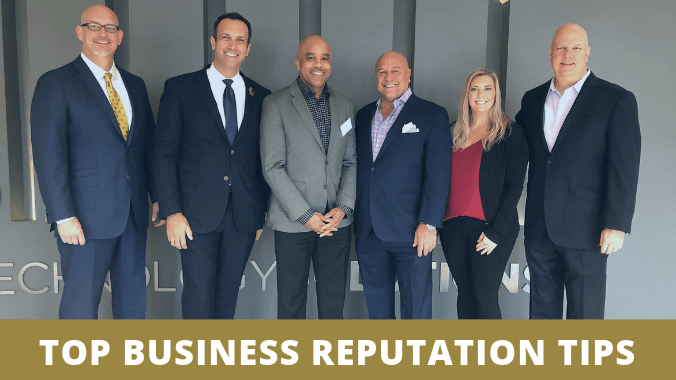
Whether or not you had the chance to attend our most recent Business Reputation Panel in person, every leader can benefit from our expert panelists’ top tips to preserve and protect your company’s reputation. James “Jef” Fagan, Principal Attorney at Offit Kurman advises businesses to not only pick a primary spokesperson – but to make certain your employees know who that spokesperson is. Legally, employees need to understand if the media calls, they should not answer any questions. If a crisis occurs, employees should be given a script for answering the phone, and direct callers to the primary spokesperson. Scott Canuel, Executive Director and Market Team Lead at J.P. Morgan explains employees must know what to expect in terms of protocol BEFORE a crisis occurs. Employees should be updated on your company’s crisis plan on a regular basis, and training must be consistent. (Fallston Group tip: this establishes organizational muscle memory and reduces stress when a crisis does occur!). Rachael Lighty, Public Relations Manager for Amazon Operations stresses that “your reputation is not a shot in time.” Your reputation must be worked on alongside your relationships with your customers and trusted advisors every single day. Think about your reputation during your everyday business decisions – it is an active ongoing process. Kai Jackson, Co-anchor at WBFF-TV Fox45 News tells us from the media’s perspective, “please know I have a job to do just like you do.” When a crisis occurs, it is extremely helpful for your company to have a point person to go to for information who can speak MEANINGFULLY about the issue. The media’s job is to report professionally and respectfully. The more substance your business can provide, the better the media will be able to represent your story. Ed Norris, radio personality and actor gives personal advice from the heart: build your relationships TODAY. And not just with your company and board’s executives, but with all of your employees. Every person matters. These relationships will benefit you in the long-term, and those people will have your back not if, but when things go sideways. Rob Weinhold, chief executive at Fallston Group, urges leaders to understand reputation leads to trust, and trust leads to valuation. And, not all currency is financial. Your reputational equity must be built BEFORE crisis strikes; your business must always be ready to make a withdrawal from your reputational piggy bank. For more information about crisis leadership strategies, how to understand your risk and how to better prepare for a crisis, contact Fallston Group at info@fallstongroup.com, call 410.420.2001 or visit our website.
Crisis Expert Rob Weinhold Launches National Keynote

Rob Weinhold, author and chief executive of Fallston Group, the Baltimore-based, global reputation agency, today announced a new national keynote speaking campaign, “Crisis is a Growth Strategy,” including the launch of Weinhold’s brand-new website, robweinhold.com. Over time, Weinhold has been relied upon to lead, manage, coach, teach, interview, keynote, conduct workshops and train a variety of organizations and individuals in the field of crisis leadership. After working with so many clients, his “crisis is a growth strategy” approach has not only driven dramatic results, it is the reason many engage. This is why Weinhold developed his new keynote presentation and workshop. In today’s turbulent world, the issue isn’t if crisis will occur, but when. Weinhold addresses how to prepare for, navigate through and recover from sensitivity, adversity and crisis. Through proper crisis leadership tactics, Weinhold teaches the importance of turning short-term adversity into long-term advantage. “Reputation leads to trust, and trust leads to valuation,” explains Weinhold. “By successfully leading an organization through life’s most difficult times, one can not only positively impact a company’s reputation, the organization will emerge bigger, faster, stronger than it was before that defining moment. Ultimately, more value is created.” Throughout his career, Weinhold has been recognized for his unique ability to lead by creating vision and building consensus across diverse stakeholder bases, even during the most sensitive of times. He is routinely called upon by members of the national and local news media to provide perspective on crisis leadership, public safety and strategic communications. After several decades of private and public sector leadership service, Weinhold launched Fallston Group nearly a decade ago to build, strengthen and defend reputations. “Rob is a captivating speaker who genuinely connects with his audience through practicality and humanness,” says Ragina Cooper Averella, Public and Government Affairs Manager for AAA Mid-Atlantic. “For a living, Rob helps leaders snatch victory from the jaws of defeat. His experience and instinct is simply invaluable.” Weinhold was recently elected to the Johns Hopkins Carey Business School’s Dean’s Advisory Council to support the School’s pursuit of innovation in business knowledge and learning while educating business leaders as citizens. Weinhold was also recognized as a 2017 Most Admired CEO by The Daily Record. He holds a graduate degree (MSM) from The Johns Hopkins University Carey School of Business and undergraduate degree from the University of Baltimore. A nationally published author, Weinhold’s book (The Art of Crisis Leadership, 2016) skyrocketed to become a #1 new release in Amazon’s PR and Crisis Management categories and top 100 in Leadership. He has also trained and lectured in many professional and academic settings. For additional information about Weinhold, to schedule an interview or book a workshop, contact Fallston Group’s Marketing Communications Manager Andrea Lynn at 410.420.2001 or by email at andrea.lynn@fallstongroup.com.
Rob’s Reflections

Admittedly, taking our first mission trip to Haiti created a strong sense of excitement and nervousness. However, the invigoration we felt before traveling abroad to help the poorest of poor children far outweighed any personal concerns, health or physical safety. Yes, we had to take a preventative approach to healthcare and embrace safety precautions while in the country, but within a few hours we were comfortable with our environment and our ability to maintain a strong sense of safety, both emotionally and physically. When people asked us about our Haiti experience, there were no words to adequately capture this transformational time in our lives. It was an awakening, like no other, where the visible level and volume of poverty was trumped by the beauty of the human spirit. We continue to be in awe of a people that had so little materially, but gave so much of their essence. During our trip, the heat was oppressive, and we didn’t have the comforts of home, or even the basics in many respects. What we did have was a wonderful, diverse travel party who gelled quickly for a singular purpose. There was something we absolutely loved about the simplicity of life without the many distractions of home, or today’s electronics. A new world opened-up and we experienced and witnessed, first hand, an unfamiliar, yet very appealing terrain. We wish every privileged person could take this trip to truly humanize the real struggle to survive and the human beauty that exists among the most desperate and dire of circumstances. The children and staff at St. Marc School is our collective happy thought. To wade among the morning sea of children who simply want to hug, smile and connect with you is surreal. Their hearts are big and smiles captivating – and, we marvel at their desire to learn. You see, school is the most stable force in many of their young lives and interacting with them was more than fulfilling. St. Marc School is a privilege to Haitian children, not a chore. Candidly, they can’t wait to come to school in the morning and don’t want to leave when the afterschool activities end. We understand why. During the school day, we found a disciplined approach within a chaotic country. The laughter, singing and playful nature of this population’s young people are magnetic. You see, the beauty and innocence of these children transcended any barometer of poverty, race or stature – the life lesson was loud and clear, we are all human beings who are in place on this earth together for a very short period of time. And, we have an inherent responsibility to help one another. The High Hopes for Haiti organization is amazing; their work is God’s work, made possible through the conviction of many to provide hope and opportunity. Our admiration for Dr. Mortel is deep as his life experience, vision and drive for results is unrelenting. He, and his team, fight for Haiti’s most vulnerable children so they, too, may one day realize their dreams, just as St. Marc native, Dr. Mortel, was able. We can think of no higher calling. There is a question we often ask of ourselves – When all is said and done, what do we want to have said and done? Since our trip to Haiti, while personally observing the essential work of the Foundation, our life’s calling is even more clear. We couldn’t be more grateful for the opportunity to serve and support our world’s young people. They are our future.
