

Rob Weinhold, CEO of Fallston Group, Shares Insight on FOX Following AWS Global Outage
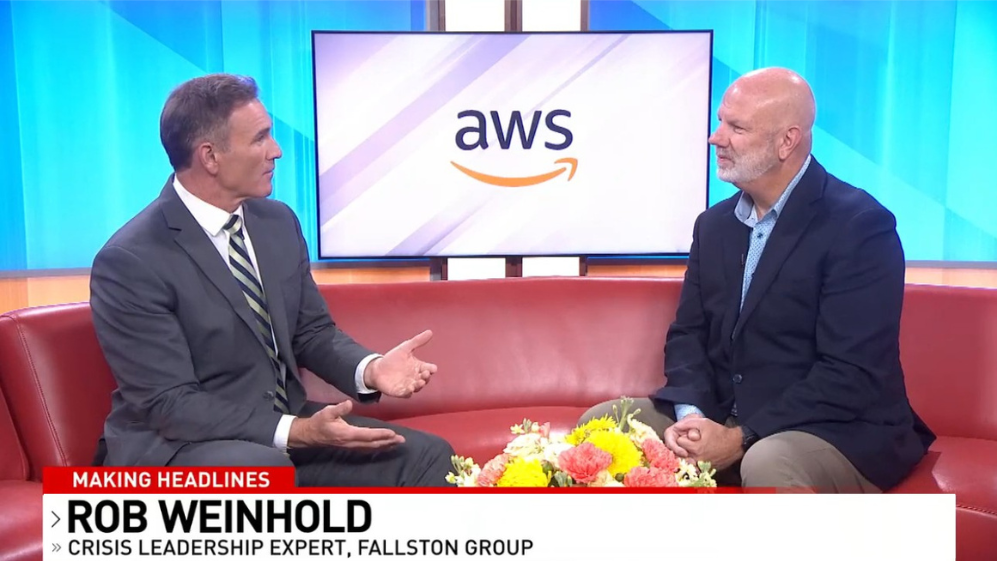
Watch interview on Fox: https://foxbaltimore.com/fox45-mornings/amazon-web-services-outage-causes-global-disruption-highlights-economic-reliance#
When the Cloud Breaks: Leadership Lessons from the AWS Outage
When the Cloud Breaks: Leadership Lessons from the AWS Outage During the early hours of October 20th, a major outage at Amazon Web Services (AWS) took hundreds of platforms offline and caused chaos for thousands of companies. Global brands like Snapchat, Venmo, Fortnite, Signal, and Ring were severely affected, along with UK institutions such as Lloyds Bank and HM Revenue & Customs. When the cloud goes down, the ripple effect hit with velocity and impact, and no organization is immune. Whether you are a global enterprise or a main street business, when your business continuity is disrupted, it can cost you time, money, customers, and careers. Moments like these separate reactive organizations from resilient ones. That’s why Fallston Group teaches the Resilient Moment Communications Model — a practical framework that guides leaders through the uncertainty of crisis. This model, developed by Dr. George Everly, provides a strategic communications path for leaders of every organizational shape and size. The Model suggests that if a leader answers the following five questions, at any stage of crisis, most questions that people have about an issue will have been answered: What happened? Be factual and transparent. AWS’s disruption apparently stemmed from an internal subsystem failure — not a cyber-attack. Clear early messaging prevents speculation from taking root. What caused it? Explain the root cause in plain language. Jargon confuses; clarity builds confidence. What are the effects? Acknowledge the human and business impact. From customer frustration to investor concern, empathy and accountability sustain trust. What is being done about it? Demonstrate decisive action. Communicate progress and solutions without over-promising. Precision and presence matter. What needs to be done in the future? Show learning and leadership. Strengthen systems, train teams, and rehearse responses before the next test. The AWS outage is a real-time reminder that resiliency is not just technical — it is organizational. As we say at Fallston Group, ‘you don’t spin your way through crisis; you lead your way through.’ Fallston Group helps leaders prepare for, navigate through, and recover from issues of sensitivity, adversity, and crisis — because reputation leads to trust, and trust leads to valuation. For more information, link to www.fallstongroup.com. – Rob Weinhold, Chief Executive of Fallston Group
Crisis Leadership: The Hidden Catalyst for Growth
It may seem counterintuitive, but crisis is not the enemy of progress—it’s often the spark that fuels it. In a world driven by relentless competition, digital disruption, and changing consumer expectations, crisis is not only inevitable—it’s essential. The real question leaders must ask is not if crisis will strike, but when. And more importantly: are you ready to meet the moment? Well-built organizations don’t just endure crisis—they invite it. They understand that when disruption hits, it reveals character, clarity, and competitive advantage. According to PwC’s 2023 Global Crisis Survey, 96% of organizations experienced at least one crisis in the past two years. Yet nearly 70% of those who were well-prepared emerged stronger. Crisis whittles down the marketplace—removing the fragile and reaffirming the future-ready. Darwinism is alive and well in today’s digitized world. Organizations either adapt—or disappear. But readiness doesn’t happen by accident. Leaders must treat crisis readiness as a core strategic investment—not an afterthought. This begins with a comprehensive reputational risk assessment to identify the threats that could compromise your brand, operations, and long-term viability. From there, organizations must build customized crisis plans—not templated checklists, but living, breathing playbooks that reflect your values, people, and culture. And most critically: you must train – how you practice is how you will play under duress. You must pressure test these plans under simulated, real-world conditions. Just like elite athletes or military teams, crisis-ready organizations drill until muscle memory kicks in. Because when the pressure is on, you don’t rise to the occasion—you fall to the level of your training. Fallston Group helps you achieve the organizational memory needed to turn short-term adversity into long-term advantage. Not being prepared in this day and age is utterly unacceptable as anyone with an internet connection and recording device can wreak havoc on your brand. Crisis is not a pitfall. It’s a proving ground. A growth strategy in disguise. The question is not whether crisis will find you—it’s whether you’ll be ready to lead when it does. Those who plan, train, and act decisively don’t just survive—they set the new standard for excellence. Remember, reputation leads to trust, and trust leads to valuation. And not all currency is financial. Invest in your readiness now to ultimately preserve your time, money, consumer confidence and career. Your reputation and your future depends on it.
Crisis Leadership in the Spotlight: Rob Weinhold Reflects on the 150th Running of the Preakness Stakes and the Economic Importance of Pimlico’s Revitalization

Fallston Group CEO Rob Weinhold appeared on Fox45 Morning News this week to discuss one of Baltimore’s most iconic—and closely watched—events: the 150th running of Preakness Stakes. With international attention on Baltimore City and the State of Maryland, Rob highlighted the significant economic development impact of high-profile events like the Preakness, stressing how they offer more than just a celebration. These events are powerful opportunities to infuse resources into the local economy, boosting tourism, creating jobs, and elevating Baltimore’s reputation on the national stage. Baltimore is in the news for all of the right reasons this week. “As Baltimore welcomes national eyes, it’s not just about the race—it’s about driving economic impact, managing public perception, and presenting the city as a leader in tourism and development,” Rob explained during the interview. “The Preakness provides an invaluable moment to harness resources and ensure the city’s legacy as a prime destination for investment and growth.” Rob also emphasized that these events test more than just the athletes involved; they challenge brands, public officials, and event organizers to deliver a unified message with clarity, confidence, and credibility. This is where Fallston Group excels. Fallston Group ensures leaders can lead effectively when the stakes are high, from event messaging to managing reputational risk during high-profile events. Whether in sports, business, or politics, we help our clients show up prepared and poised for success—both on and off the track.
Honored and Rooted: Fallston Group Recognized Among Greater Baltimore’s Top Family-Owned Businesses

Fallston Group is grateful to announce that the Baltimore Business Journal has recognized us as one of Greater Baltimore’s top family-owned businesses for 2025! This honor, part of the BBJ’s annual Family-Owned Business Awards, celebrates companies that have demonstrated excellence, innovation, ethics, and philanthropy—qualities we strive to embody every day. We are especially grateful to stand alongside other businesses that, like us, have put down deep roots in Maryland and built trust across generations. Fallston Group was founded with a simple but powerful mission: help people during life’s most critical times – it’s baked into our DNA. As a family-owned business, we approach our work with a personal sense of responsibility—not just to our clients, but to the community we call home. Our team’s commitment to reputation management and crisis leadership isn’t just about business but legacy, accountability, and impact. Our work is more relevant than ever in today’s rapidly changing world. Trust is fragile, and brand equity can be won or lost in a single moment. We’re here to safeguard our clients’ reputations and turn short-term adversity into long-term advantage with clarity, conviction, and care. Thank you to the Baltimore Business Journal for this meaningful recognition, and congratulations to our fellow honorees. We look forward to continuing to serve our clients, partners, and the Greater Baltimore community for years to come.
Cap One – a Capitalist’s Drive for Growth
Reflecting on the recent announcement that Capital One plans to acquire Discover, it is impressive to see the strategic positioning and drive for Capital One to continue its growth patterns. Capital One has a good track record for growth, as it boasts that it has exceeded numerous growth targets since its creation in 1994. This type of track record doesn’t happen by accident. It takes a clear strategy and, most importantly, a dedicated focus on execution. An effective short-, mid-, and long-term strategy is rooted in having a clear understanding of and focus on your company’s unique advantages, which then translates to a winning proposition in the marketplace. Also, it is important to plan for execution to meet organizational goals. This requires a commitment to focus and relentless attention on many execution details daily to achieve success. Then, enterprising, growth-minded companies drive growth and set even higher goals to achieve success within their marketplaces. This is what brings Capital One to the plan to acquire Discover….an internal strategic drive to move on to the next step of change in performance for the company and its investors. By acquiring Discover, Capital One moves strategically into a new world where they can compete with Visa and Mastercard to provide a globally competitive payments network while also capturing numerous other synergies in the card business from the combined companies. I bet Capital One delivers on its aspirations since they have a demonstrated track record for solid execution – the most important predictor of success being past performance. More competition in the card payments field should also benefit retailers and consumers! Does your organization have an established strategic plan and leveraged pathway to success? If not, contact us to learn more about the various models we implement to help organizations activate their mission, vision, and values.
Hostage Negotiations – A Blueprint for Everyday Life
Just a few short weeks ago, Fallston Group was honored to have delivered the opening keynote at the National Tactical Officer’s Association’s (NTOA) Crisis Negotiations Conference in Scottsdale, Arizona. There were more than six hundred crisis negotiators sharpening their craft to diffuse and deescalate life’s most difficult situations and save lives. Yes, these are ordinary men and women thrust into extraordinary circumstances at a moment’s notice. It’s an awesome responsibility where these chosen law enforcement strategists must play games of chess, not checkers. In our daily lives, the traits that define successful hostage negotiators can serve as valuable guiding principles, helping us navigate challenges, communicate effectively, and build stronger connections with those around us. Don’t we need more human connection in today’s world? Let’s look at some of the key attributes needed to competently manage this high-stakes game and normal everyday life. Communication: Mastering the art of effective communication is a universal skill that transcends crisis scenarios. Whether in personal relationships, the workplace, or community interactions, the ability to express oneself clearly and assertively fosters understanding and mutual respect. By articulating thoughts with precision, we can enhance our capacity to influence positive outcomes. Let’s not forget the most important part of the communication process is the ability to be an effective listener. Empathy and Emotional Intelligence: In the fabric of everyday life, empathy and emotional intelligence form the foundation of meaningful connections. Understanding the emotions of others allows us to build stronger relationships and navigate conflicts with compassion. In family dynamics, friendships, and professional settings, the ability to empathize fosters a sense of unity and cooperation. Empathy is also the single attribute that sets the best leaders in the world apart from others. Adaptability and Flexibility: Life is inherently dynamic, and the ability to adapt and be flexible is paramount. Whether facing unexpected challenges at work, adjusting to changes in personal circumstances, or navigating shifting priorities, embracing adaptability ensures resilience and the capacity to thrive in the face of uncertainty. I had an old sergeant once tell me, ‘The only thing in life that’s constant is change. As soon as you realize this, you’ll be better off.’ I think he noticed my inflexibility at such a young age! Patience and Resilience: Every journey comes with its share of setbacks and obstacles. Patience and resilience equip us to endure hardships, learn from experiences, and persevere in the pursuit of our goals. These traits are invaluable in maintaining composure during challenging times and bouncing back with newfound strength. Yes, it is hard to wait and be patient in today’s ‘hurry-up’ world, but time is often the most important asset you have on your side. Strategic Thinking and Decision-Making: Strategic thinking isn’t limited to boardrooms and crisis situations; it’s a skill that enhances decision-making in all aspects of life. Whether planning personal goals, managing time effectively, or addressing complex issues, strategic thinking guides us in making informed choices that align with our long-term objectives. Research shows that people would rather follow someone who makes a wrong decision than no decision. It’s imperative to create your own future by making decisions, realizing that not all of them will be right. That’s okay; it’s how we learn and become better tomorrow than we were today. The traits of successful hostage negotiators are not confined to high-stakes scenarios. They are principles that, when integrated into our daily lives, empower us to communicate effectively, build meaningful connections, navigate challenges with grace, and make strategic decisions that contribute to our overall well-being and success. By embracing these traits, we cultivate a mindset that not only enriches our individual experiences but also positively impacts the world around us.
Peloton’s Lack of Planning: Part II

Earlier in the year, Peloton experienced troubles related to its leadership decisions during the coronavirus pandemic to expand well beyond its means. As part of their earlier strategic solution stable, Peloton decided to reduce the cost of its products. Those steps have not materially helped valuation so now, ironically, it is shifting to raise the cost of its products, close a significant number of stores and cut approximately 780 jobs. Their CEO has communicated their new focus is now on cash generation to give life to the company. For those that have been in business for a while, it is not a surprise that cash generation is important; in fact, we’ve heard the phrase ‘cash is king’ for generations. Alarmingly, Peloton to now come to this realization is striking. So, what are some of the fundamentals that seem to be missing? As we wrote earlier this year, Peloton seemed to have material gaps in their business planning (Read Previous Peloton Blog). In a sound business, they would be thinking about evaluating critical decisions across several possible scenarios to ensure the business is robust in a world that is constantly changing and dynamic. Another apparent strategic gap relates to risk management. Here are just a few risks that have materialized: Peloton had their exercise bikes used on two television series to ‘kill-off’ main characters; they have had parts falling off their equipment; some Peloton equipment has been labeled a safety hazard for children. And Peloton has had significant failures in the financial viability of their decisions. Solid organizations must have an annual process to review the risks to the business, and a more frequent cadence during unstable times. What are the customer risks? What are the market risks? How about legal and reputational risks? What other factors should they worry about that could impact their future success? Getting those strategic risks on the table to discuss and plan for would generate ideas on how to reduce the likelihood of those risks materializing. Once identified, there is no question that short-term adversity can translate into long-term advantage if properly managed. More sound strategic minded leaders could have helped avoid the sad personal impacts to Peloton employees and their families. And Peloton’s user customer base is likely a bit worried about the future value of the expensive exercise equipment if the company cannot succeed for the long term on delivering content to keep them biking. To learn more about appropriate strategic planning and risk mitigation, feel free to contact any one of our experts. Crisis cost time, money, customers, and careers, generally in that order. Peloton seems to be hitting on a number of these cylinders now.
What is Earned Media?

Kathleen Carins, EMMY Award-winning Television Journalist, who now uses her expertise as a Fallston Group Media Coach and Communications Strategist, shares her insights on “earned media” and some of the nuances involved.
Best Practices for Crisis Management in Corporations

As we all learned from Covid-19, everything changes when a crisis occurs. In the case of Covid-19, the unexpected and immense changes that erupted as a direct result of the pandemic impacted the course of history forever. Some might say that the change was for the good (remote work and blended models are now widespread and we care more about personal and public health). Some might say that the change was meant to wake us up to environmental issues. Some would say that the mask policies that were put into place because of Covid tested the willingness of the common person to put up with temporary discomfort for the betterment of everyone (recovery from the pandemic and a return to normal). Many would say that it tested our response rate to a widespread crisis. The truth is that there is a lot we can learn from Covid-19 when it comes to crisis leadership and best practices for handling adversity & crisis. Naturally, there were a lot of questions and a lot of solutions that were enacted quickly (as a crisis response) when covid-19 emerged. After all, there was no choice but to respond (the world, the country, government officials, business leaders and, yes, each of us). And the best practices for crisis resolution were generally respected. Attempts were made to respond accurately, consistently, and quickly. Whether we took it seriously or not was up to us. With millions of Americans dead, the virus took a huge toll on American lives and not everyone agreed with the Covid-19 response. The good news was that we responded effectively enough to learn a great amount from Covid-19 – understandably, the debate will continue about how effectively. In truth, no one was adequately prepared for such a widespread event. Combine a lack of preparation with a huge need to respond and you get a great, but costly, learning experience. Questions like “How will the economy fare?”, and “How long will they quarantine?”, and “when students (and workers) should return to work?” erupted. They followed with “When should mask mandate policies be removed?” and “will everyone take the vaccine when it comes out or will incentives need to be put in place?” These questions and answers were naturally debated, and they caused controversy as not everything was perfect. Still, whether it was perfect or not, the truth is that there was a crisis and there was a response. The response was very fast as borders closed, and everyone was told to stay at home and situationally wear a mask. Store supply and demand was tested (items were off the shelves quickly and were replenished). Stimulus checks were given. Vaccines were developed very quickly, and while there were setbacks, the good news was that the rollout of the vaccines quickened, and they were available to the public free of cost. Healthcare workers did a phenomenal job and were heroes during this dire time. The public also did its part overall (even though many didn’t want to cooperate). Lastly, the spread of misinformation about the disease had to be scrutinized over, and journalists and scientists were on the job to make sure we knew what was true from what was false – again, some will continue to debate. At the end of the day, our response improved over time. What we’ve learned from the pandemic is that a massive and life-altering crisis can happen, and there’s going to be a lot of uncertainty (and fear) and that it can change our ‘normal.’ So, as everyone has learned (and been humbled by in terms of the pandemic), a crisis is an unexpected or smoldering event that results in an emergency response. Serious and potentially devastating crisis events must be prepared for. If not, there is potential for company embarrassment, loss of money, loss of time, and loss of company or personal morale and loss of life. The good news is that we can prepare for a crisis, and we can learn from how other companies handled crisis events. The bad news is that corporations have not been known for having the best responses to crisis. No, in fact an emergence in crisis management is the direct result of the shortage of effective crisis management. So, now that we know that our crisis response can improve, it’s good to know that there won’t be an excuse anymore not to prepare for the worst events. With enough literature, statistics, and research out on the topic however we all can be prepared to handle what comes our way. If we start with foresight and a predictive mindset, it’s a brilliant way to start. Some of the best plans include having the foresight so see what crisis might come, evaluating plans for each crisis, and of course electing the best leaders, teams and spokespeople to become directly involved with every step of the crisis. With the right recommendations and the right people, a crisis response will break down into before, during, and after crisis stages. There is no doubt organizations can turn short-term adversity into long-term advantage. When it comes to a crisis response, we can start by looking at the numbers, and see crisis management a little more clearly, but the most important statistics on crisis management are as follows: less than 30% of respondents in a recent global crisis survey felt that their businesses crisis management functions were well composed. Yes, and of course, over 70% of respondents said that technology would help significantly with the organization and outcome of a crisis response team. Most importantly, most (or over 70% of business leaders) reported having a crisis happen to them within a period of the last 5 years. Most of the individuals (more than 90% of those surveyed) believed that a crisis would happen to them within the next two years, but less than 35% of people believed that their company was prepared. According to these statistics, risk can’t be ignored. According to Deloitte, the areas that frequently involve
