

When the Cloud Breaks: Leadership Lessons from the AWS Outage
When the Cloud Breaks: Leadership Lessons from the AWS Outage During the early hours of October 20th, a major outage at Amazon Web Services (AWS) took hundreds of platforms offline and caused chaos for thousands of companies. Global brands like Snapchat, Venmo, Fortnite, Signal, and Ring were severely affected, along with UK institutions such as Lloyds Bank and HM Revenue & Customs. When the cloud goes down, the ripple effect hit with velocity and impact, and no organization is immune. Whether you are a global enterprise or a main street business, when your business continuity is disrupted, it can cost you time, money, customers, and careers. Moments like these separate reactive organizations from resilient ones. That’s why Fallston Group teaches the Resilient Moment Communications Model — a practical framework that guides leaders through the uncertainty of crisis. This model, developed by Dr. George Everly, provides a strategic communications path for leaders of every organizational shape and size. The Model suggests that if a leader answers the following five questions, at any stage of crisis, most questions that people have about an issue will have been answered: What happened? Be factual and transparent. AWS’s disruption apparently stemmed from an internal subsystem failure — not a cyber-attack. Clear early messaging prevents speculation from taking root. What caused it? Explain the root cause in plain language. Jargon confuses; clarity builds confidence. What are the effects? Acknowledge the human and business impact. From customer frustration to investor concern, empathy and accountability sustain trust. What is being done about it? Demonstrate decisive action. Communicate progress and solutions without over-promising. Precision and presence matter. What needs to be done in the future? Show learning and leadership. Strengthen systems, train teams, and rehearse responses before the next test. The AWS outage is a real-time reminder that resiliency is not just technical — it is organizational. As we say at Fallston Group, ‘you don’t spin your way through crisis; you lead your way through.’ Fallston Group helps leaders prepare for, navigate through, and recover from issues of sensitivity, adversity, and crisis — because reputation leads to trust, and trust leads to valuation. For more information, link to www.fallstongroup.com. – Rob Weinhold, Chief Executive of Fallston Group
Honored and Rooted: Fallston Group Recognized Among Greater Baltimore’s Top Family-Owned Businesses

Fallston Group is grateful to announce that the Baltimore Business Journal has recognized us as one of Greater Baltimore’s top family-owned businesses for 2025! This honor, part of the BBJ’s annual Family-Owned Business Awards, celebrates companies that have demonstrated excellence, innovation, ethics, and philanthropy—qualities we strive to embody every day. We are especially grateful to stand alongside other businesses that, like us, have put down deep roots in Maryland and built trust across generations. Fallston Group was founded with a simple but powerful mission: help people during life’s most critical times – it’s baked into our DNA. As a family-owned business, we approach our work with a personal sense of responsibility—not just to our clients, but to the community we call home. Our team’s commitment to reputation management and crisis leadership isn’t just about business but legacy, accountability, and impact. Our work is more relevant than ever in today’s rapidly changing world. Trust is fragile, and brand equity can be won or lost in a single moment. We’re here to safeguard our clients’ reputations and turn short-term adversity into long-term advantage with clarity, conviction, and care. Thank you to the Baltimore Business Journal for this meaningful recognition, and congratulations to our fellow honorees. We look forward to continuing to serve our clients, partners, and the Greater Baltimore community for years to come.
The Real-World Cost of Digital Recklessness: A Call for Accountability
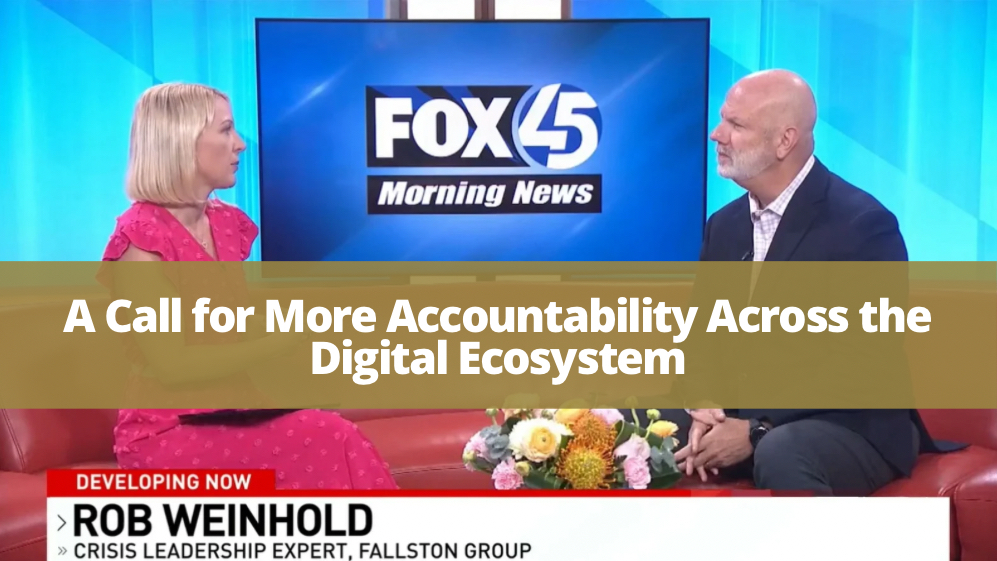
In today’s hyperconnected and always-on digital world, the viral spread of misinformation can rapidly and irrevocably damage lives. At Fallston Group, we’ve spent decades advising organizations and individuals during their most critical moments—and if one truth has become abundantly clear, it’s this: digital recklessness has very real, often life-altering consequences. The recent situation involving Mary Kate Cornett, a college freshman at the University of Mississippi, underscores the urgent need for greater accountability across our digital ecosystem. Based on publicly available reports, Ms. Cornett—by all accounts,a promising first-year business student—found herself at the center of a viral firestorm after an anonymous and unverified post was made on the YikYak platform on February 25th. What began as a baseless rumor quickly spiraled across platforms like X (formerly Twitter), drawing the attention of high-profile commentators and online audiences. Her name and likeness were circulated widely without her consent, often without credible facts. While those spreading the story may have viewed it as a moment of entertainment or gossip, the human cost to Ms. Cornett was significant and deeply personal. This moment is not about adjudicating guilt or intent—it’s about acknowledging a broader systemic and human failure. It’s a cautionary tale for institutions, influencers, and individuals alike. And it’s one of many such stories in a time when reputations can be compromised with a single click. Five Critical Crisis Leadership Observations 1. Real People, Real Pain Behind every viral moment is a real person. In this case, a young woman’s formative college experience has reportedly been upended by an untrue narrative. Reputational harm doesn’t just affect public figures—it affects students, professionals, and everyday citizens whose lives are impacted by reckless digital behavior. 2. Platforms Must Act—Swiftly and Transparently Social media companies must continue to evolve their moderation and response capabilities to address harmful content in real time. Whether it’s anonymous platforms or large-scale social networks, delayed action contributes to widespread harm. 3. Content Amplifiers Must Use Their Platforms Responsibly While sports media and digital commentary platforms play an important role in modern discourse, the line between free speech and reputational harm must be navigated with care. Those with influence must be thoughtful and discerning—particularly when discussing unverified claims involving private individuals. 4. Accountability Must Be a Shared Priority Whether through corporate governance, advertiser pressure, or public expectations, digital amplifiers must be held to higher standards. The systems that allow misinformation to thrive must be reviewed, reformed, and enforced through responsible action. 5. Digital Education Is a Survival Skill Colleges, universities, and families have a growing responsibility to educate young people about the risks of digital exposure. Media literacy, digital resilience, and reputation defense must be integrated into the student experience. These aren’t “nice-to-haves”—they’re essentials in today’s reputational landscape. At Fallston Group, we often remind our clients that reputation leads to trust, and trust leads to valuation—and not all currency is financial. In fact, in many cases, reputational currency is what opens doors, secures relationships, and sustains opportunity. To those affected by the irresponsible spread of misinformation: you are not alone. And to those with a microphone or platform—whether digital or traditional—remember that your influence is a responsibility, not a right. If you are an academic center of excellence—particularly within higher education—and wish to ensure your students and stakeholders are properly educated and protected in today’s fast-paced, high-stakes media environment, contact Fallston Group. Our crisis leadership experts can help you develop proactive training, reputational safeguards, and crisis response protocols tailored to your institution. The stakes are too high to wait. All of us must be ready to meet the moment.
Fallston Group Activates Southeastern Region Location

Fallston Group, a distinguished leader in crisis leadership, public relations, strategic communications, and reputation management, announces the inauguration of its presence in Tampa, Florida, now serving the Southeastern region of the United States. The strategic expansion amplifies Fallston Group’s commitment to assisting organizations (proactively and reactively) with crisis leadership services, equipping organizations who must navigate turbulent times with precision, clarity, and resilience. Fallston Group, which works with private, public, and nonprofit organizations, as well as individuals in need, has been building, strengthening, and defending reputations since the company was founded 15 years ago in Baltimore, Maryland. Fallston Group is a renowned authority in crisis leadership and strategic communication. The regional team brings more than two hundred years of combined professional experience to assist clients in effectively managing their decisions, narratives, and brands in the most challenging circumstances. “If you don’t tell your story, someone else will. And when someone else tells your story, it certainly won’t be the story you want told,” remarked Rob Weinhold, Chief Executive of Fallston Group. “You don’t spin your way through a crisis; you lead your way through. While counterintuitive, crises are growth opportunities not to be feared.” Weinhold adds, “We know how to turn short-term adversity into long-term advantage, saving clients time, money, customers, careers, and in the worst of scenarios, freedom, and lives. It is not a matter of ‘if’ but ‘when’ crisis strikes, as anyone with an internet connection and/or recording device can wreak havoc on your brand. The new southeastern regional presence, centered in Tampa, Florida, signifies Fallston Group’s unwavering commitment to delivering exceptional services tailored to client needs, particularly in crisis leadership, strategic communication, public relations, and media training. Whether guiding businesses through reputational crises or creating organizational muscle memory to enhance crisis preparedness, Fallston Group remains a trusted partner dedicated to safeguarding client reputations and valuation. The firm operates at the critical intersection of leadership, strategy, and communications. “We are thrilled to broaden our footprint,” continued Weinhold. Our team will work closely with leaders in the region, equipping them with the tools and strategies necessary to navigate any sensitive, adverse, or crisis-oriented issues.” Fallston Group’s expansion represents a significant milestone in the company’s 15-year trajectory, reflecting its ongoing commitment to excellence while supporting its domestic and international clients.
Hostage Negotiations – A Blueprint for Everyday Life
Just a few short weeks ago, Fallston Group was honored to have delivered the opening keynote at the National Tactical Officer’s Association’s (NTOA) Crisis Negotiations Conference in Scottsdale, Arizona. There were more than six hundred crisis negotiators sharpening their craft to diffuse and deescalate life’s most difficult situations and save lives. Yes, these are ordinary men and women thrust into extraordinary circumstances at a moment’s notice. It’s an awesome responsibility where these chosen law enforcement strategists must play games of chess, not checkers. In our daily lives, the traits that define successful hostage negotiators can serve as valuable guiding principles, helping us navigate challenges, communicate effectively, and build stronger connections with those around us. Don’t we need more human connection in today’s world? Let’s look at some of the key attributes needed to competently manage this high-stakes game and normal everyday life. Communication: Mastering the art of effective communication is a universal skill that transcends crisis scenarios. Whether in personal relationships, the workplace, or community interactions, the ability to express oneself clearly and assertively fosters understanding and mutual respect. By articulating thoughts with precision, we can enhance our capacity to influence positive outcomes. Let’s not forget the most important part of the communication process is the ability to be an effective listener. Empathy and Emotional Intelligence: In the fabric of everyday life, empathy and emotional intelligence form the foundation of meaningful connections. Understanding the emotions of others allows us to build stronger relationships and navigate conflicts with compassion. In family dynamics, friendships, and professional settings, the ability to empathize fosters a sense of unity and cooperation. Empathy is also the single attribute that sets the best leaders in the world apart from others. Adaptability and Flexibility: Life is inherently dynamic, and the ability to adapt and be flexible is paramount. Whether facing unexpected challenges at work, adjusting to changes in personal circumstances, or navigating shifting priorities, embracing adaptability ensures resilience and the capacity to thrive in the face of uncertainty. I had an old sergeant once tell me, ‘The only thing in life that’s constant is change. As soon as you realize this, you’ll be better off.’ I think he noticed my inflexibility at such a young age! Patience and Resilience: Every journey comes with its share of setbacks and obstacles. Patience and resilience equip us to endure hardships, learn from experiences, and persevere in the pursuit of our goals. These traits are invaluable in maintaining composure during challenging times and bouncing back with newfound strength. Yes, it is hard to wait and be patient in today’s ‘hurry-up’ world, but time is often the most important asset you have on your side. Strategic Thinking and Decision-Making: Strategic thinking isn’t limited to boardrooms and crisis situations; it’s a skill that enhances decision-making in all aspects of life. Whether planning personal goals, managing time effectively, or addressing complex issues, strategic thinking guides us in making informed choices that align with our long-term objectives. Research shows that people would rather follow someone who makes a wrong decision than no decision. It’s imperative to create your own future by making decisions, realizing that not all of them will be right. That’s okay; it’s how we learn and become better tomorrow than we were today. The traits of successful hostage negotiators are not confined to high-stakes scenarios. They are principles that, when integrated into our daily lives, empower us to communicate effectively, build meaningful connections, navigate challenges with grace, and make strategic decisions that contribute to our overall well-being and success. By embracing these traits, we cultivate a mindset that not only enriches our individual experiences but also positively impacts the world around us.
Peloton’s Lack of Planning: Part II

Earlier in the year, Peloton experienced troubles related to its leadership decisions during the coronavirus pandemic to expand well beyond its means. As part of their earlier strategic solution stable, Peloton decided to reduce the cost of its products. Those steps have not materially helped valuation so now, ironically, it is shifting to raise the cost of its products, close a significant number of stores and cut approximately 780 jobs. Their CEO has communicated their new focus is now on cash generation to give life to the company. For those that have been in business for a while, it is not a surprise that cash generation is important; in fact, we’ve heard the phrase ‘cash is king’ for generations. Alarmingly, Peloton to now come to this realization is striking. So, what are some of the fundamentals that seem to be missing? As we wrote earlier this year, Peloton seemed to have material gaps in their business planning (Read Previous Peloton Blog). In a sound business, they would be thinking about evaluating critical decisions across several possible scenarios to ensure the business is robust in a world that is constantly changing and dynamic. Another apparent strategic gap relates to risk management. Here are just a few risks that have materialized: Peloton had their exercise bikes used on two television series to ‘kill-off’ main characters; they have had parts falling off their equipment; some Peloton equipment has been labeled a safety hazard for children. And Peloton has had significant failures in the financial viability of their decisions. Solid organizations must have an annual process to review the risks to the business, and a more frequent cadence during unstable times. What are the customer risks? What are the market risks? How about legal and reputational risks? What other factors should they worry about that could impact their future success? Getting those strategic risks on the table to discuss and plan for would generate ideas on how to reduce the likelihood of those risks materializing. Once identified, there is no question that short-term adversity can translate into long-term advantage if properly managed. More sound strategic minded leaders could have helped avoid the sad personal impacts to Peloton employees and their families. And Peloton’s user customer base is likely a bit worried about the future value of the expensive exercise equipment if the company cannot succeed for the long term on delivering content to keep them biking. To learn more about appropriate strategic planning and risk mitigation, feel free to contact any one of our experts. Crisis cost time, money, customers, and careers, generally in that order. Peloton seems to be hitting on a number of these cylinders now.
Reputation leads to Trust and Trust leads to Valuation… And, Not All Currency is Financial.

Successful leaders and organizations understand the value of building, strengthening, and defending their reputation. Reputation is defined as: the beliefs or opinions that are generally held about someone or something. If we take a broader look at society, we believe that consumers are morally aligned with the brands they invest in and purchase from, more than they ever have before. In fact, 92% of millennials prefer to purchase from companies they feel are ethical….and 70% of them will pay more for products and services from socially responsible companies. So, the question is…what is the real value of investing in your reputation? Our answer, priceless. It is crucial to establish a business with a healthy foundation that embraces sound leadership, strategy, and communications tenants, and enables a transparent relationship with your workforce and consumer base. The court of public opinion is interested in who you are and what you have to say as a brand – especially when crisis occurs. Remember, the court of public opinion renders judgments much more quickly than any other ‘court.’ Not too long ago, Wells Fargo was leading the headlines for creating fraudulent savings and checking account on behalf of clients without their consent. What happened? Misreported sales numbers, billions in settlements, significant stock underperformance, and a change in leadership at the top. In a different but related event with Boeing, investigators found faulty 737 Max designs and training manuals which contributed to hundreds of deaths and grounding of hundreds of aircrafts. Once the news broke, their CEO was terminated and numerous layoffs occurred. The lawsuits began to pile in, $18 billion earnings loss (2019), and again a significant drop in the stock price. We tell every client, “reputation leads to trust, and trust leads to valuation – and remember, not all currency is financial” – because it’s the truth. By creating a strong relationship with your stakeholder base, and proactively telling your story, you can maintain a brand with a healthy reputation that is essential for success in today’s world.
Uh-oh…Hot Mic!

Have you ever said something you thought was confidential, but soon realized someone or some ‘thing’ overheard you? The inevitable answer is yes – we all have. However, the consequences of ‘sticking your foot in your mouth’ are much more severe today than they were years ago. Why? The answer is simple – technology. At Fallston Group we often tell our clients “anyone with an internet connection and recording device can wreak havoc on your brand.” This happens within seconds or minutes. The speed of information is faster now than ever before, and so are its verdicts – in other words, the court of public opinion is alive and well. But what’s different than the court of law, is the court of public opinion is judging not only current events but history within a modern, real-time context. Consumers feel empowered more than they ever have before, because of social media and other digital platforms. And not just to criticize and attack specific brands, but to generally share their opinions on brands, issues, events, etc. Consumers will vote with their heart, their wallet, their voice… and, we must adapt to today’s environment. A recent example is (now former) veteran NHL referee, Tim Peel, who ruined his reputation and career in a matter of seconds. Peel was being recorded during a National Hockey League regular-season game (as most professional referees, umpires, sports games, and even players usually are) and during the first several minutes of the game, Peel stated to another referee: “it wasn’t much, but I wanted to get a f***** penalty against Nashville early…” (Dedaj, 2021). Once the audio was analyzed by league executives, Peel was stripped of all his professional refereeing duties, but scrutiny didn’t stop there. When it comes to the court of public opinion, assumptions were quickly made, and questions were asked. People wondered, are his comments related to sports gambling? Is he a Red Wings fan (the opposing team)? Ultimately, what is his bias? Regardless of the ‘why,’ the awareness of his actions, words, and environment are the reasons his career is now tarnished, and reputation is ruined. This surely isn’t the first (or the last) time we have watched careers mushroom cloud within a matter of minutes. Always remember, when you’re with the news media, your mic is always ‘hot.’ In fact, with technology being as pervasive as it is today, it seems there is always a ‘hot’ mic or video wherever you go! Now, if you find yourself on the wrong end of a ‘hot’ mic, we’re often asked what to do, regardless of how devastating the recorded comments or actions are. We believe you start by embracing Dr. George Everly’s Resilient Moment Communications Model. The Model suggests that if you answer the following questions, the overwhelming majority of the questions people have, will be answered: What happened? What caused it? What are the effects? What is being done now? What needs to be done in the future? While telling your story using this framework won’t make the issue immediately go away, it will go a long way to articulate your position, whether the court of public opinion agrees with you or not. Bottom line remember you are always ‘HOT’!
Tiger Woods – Legacy and Reputation
Tiger Woods is often referred to as one of the best, if not the best, player in PGA Tour history. Tiger is tied for the most PGA Tour wins with Sam Snead, and currently is second to the great Jack Nicklaus for most Majors won. His entire life is focused on winning – which is depicted in the most recent HBO (2021) documentary “Tiger.” The show is a dark look at Tiger the individual, and not just Tiger the golfer, which has his fans, other professional players, and some media crying foul. People don’t like to see the downfall of someone they cheered for and even emulated. For many years, Tiger was known as a genuine but private person, and a phenomenal golfer and athlete. His reputation was clean, and people knew Tiger was breaking racial barriers in the sport of golf. This was a guy who was and is under a microscope – and the entire world, golf fan or not, was watching him. When his personal life imploded in 2009, the court of public opinion took a hard stand. Companies and people chose to not be associated with someone who cheated on their wife, went into addictive treatment, and disappointed many in the community. When the sex scandal first hit the news, sponsors such as Gatorade and Gillette dropped Tiger as a brand ambassador, as they were aware of the impact the bad press may have on their brand acceptance. And that’s the key – whether it’s public or private corporations, pro athletes or entertainers, nonprofits or NGOs, there is an ardent responsibility (some would say an impossibility) to maintain a near-perfect image to ensure supporters stay aligned with their brands and with the individual. Unfortunately, when the video of Tiger’s DUI arrest surfaced, many who screamed his name on hole 18 were now screaming for other reasons. Fallston Group developed and routinely embraces the “15-70-15 Paradigm.” The 15% on each side of the 70% represents the unwavering ambassadors or detractors – in this case, those who will always love Tiger on one end, and those will always dislike him on the other. The 70% in the middle represents the real objective jury in the court of public opinion – those who will “render verdict” about Tiger, his brand, and his decisions, once they learn all the facts. This is generally true for any company or person who finds themselves in crisis. Very simply, reputation leads to trust and trust leads to valuation – and not all currency is financial. It does not matter how many Majors Tiger wins, or how much he donates to his charities – Tiger, at times, realized the diminished trust of his supporters, and that his valuation and reputation has suffered. And, if you’re wondering how much his reputational crisis cost – Tiger lost about $34 million in lost sponsorships according to Bleacher Report (Chriswell, 2011). It has been 12 years since the 2009 sex scandal, and HBO certainly made it clear that the public will determine Tiger’s legacy based on his actions and the inevitable impact. Ironically enough, Tiger is not the only person or entity being judged – since HBO released the documentary, the court of public opinion is again judging, this time it’s HBO, for its depiction of Tiger. Despite how negatively Tiger was positioned in the show, people will still make their own judgement about who Tiger is (and was) – a golfer, a philanthropist, a recovering addict…or maybe all these things. Tiger Woods has learned some hard lessons. Warren Buffet said it best – “It takes 20 years to build a reputation and five minutes to ruin it. If you think about that, you’ll do things differently”. And, as we say at Fallston Group: When all is said and done, what do you want to have said and done. We wish Tiger a speedy recovery so he can continue his life’s journey, filled with peace and happiness.
Does ‘Cancel Culture’ Pose a Threat to Our Freedom?
Cancel Culture refers to the popular practice of withdrawing support for public figures and companies after they have done or said something considered objectionable or offensive (Dictionary.com). Rob Weinhold, Fallston Group’s Chief Executive and resident crisis leadership expert was on the air discussing Cancel Culture and how it has affected even the largest and most well-known brands.
