

Why Do You Need a Crisis Communications Plan?

Crisis Communications Plans are designed to provide guidance and easy-to-follow steps to support clients in preparation for, management of and after-effects of proper crisis communications. Reputation leads to trust, trust leads to valuation. Effective crisis prevention, identification and communication rely heavily on education, training, professional judgment and experience of an internally formed Crisis Management Team (CMT), which clients learn how to create by following instructions within the plans Fallston Group creates. The CMT’s ability to manage smoldering issues and understand ways in which issues can escalate is essential to effective crisis response and recovery. Crisis communication is integral in the protection of people, assets and brands. Organizations that wait to respond, hesitate or lack visibility of action create uncertainty and anger – it diminishes marketplace trust. Client CMT’s must efficiently and effectively communicate so others do not fill the informational gap created by silence or misinformation. Any employee who is not authorized as a spokesperson should not make statements, comments or declarations internally, externally, to vendors, media, on social media, etc. All employees should direct inquiries to the designated (and trained) primary and secondary spokespeople. When an emergency occurs, the need to factually communicate is immediate. If client operations are disrupted, all stakeholders will want to know how they will be impacted. Regulators may need to be notified, and local government officials will want to know what is going on in their community. Employees and their families will be concerned and want information. Neighbors living near the impacted area may need information—especially if they are threatened by the incident. All of these “audiences” will want information before the organization has a chance to begin communicating. Velocity and accuracy is key – the crisis communications plan facilitates speed and process – organizational muscle memory is created. A vital component of handling an incident is the crisis communications strategy. Clients must be able to respond promptly, accurately and confidently during emergent circumstances in the seconds, hours, days and weeks that follow. A diverse audience pool must be reached with information specific to their unique interests and needs. Client image will be positively or negatively impacted by public perceptions and the handling of the incident from a leadership, strategy and communications standpoint. Planning is power. With new technology, it can be the anonymous public who often “break” a crisis. Therefore, unlike earlier eras, the crisis management team cannot afford to simply “manage the media.” Remember, anyone with an internet connection and a recording device can wreak havoc on your brand. Fallston Group’s mantra is alive and well, “If you don’t tell your story, someone else will. And, when someone else tells your story, it certainly won’t be the story you want told.” From a leadership standpoint, you must be ready to meet the moment, the 60 MINUTES moment, if need be. Your legacy depends on it. To learn more about Fallston Group’s crisis management work, click here, or contact us to discuss a Crisis Communications Plan for your team.
Be Kind to One Another: Did Ellen Practice What She Preached?

A year ago, if you asked me to name a celebrity who has been successful in building a strong and positive reputation, Ellen DeGeneres would have come to mind fairly quickly. In her rise to fame, she has sung, she has danced, and she has made many people belly laugh with her quick-punch jokes and witty humor. She has told inspirational stories, given to the needy and worthwhile causes, treated unsung heroes like superstars, and has become best of friends with more Hollywood A-listers than can be counted. Bottom line – people generally like Ellen. She has been on top of the world for quite some time. And for that reason, it’s possible that she and her producers never worried too much about reputational risk. After all, she’s ELLEN. Talk about a big assumption, a significant oversight, and gigantic lesson learned. What actually happened in Ellen’s production studio? How aware or involved was Ellen? Good questions, but at this juncture, likely also moot points. The damage is done. Think about how many people out there are feeling different about Ellen, the celebrity they respected and idolized today? The headlines are no longer about the check she presented to a school, an amazing guest who wowed Ellen enthusiasts on her afternoon show with some kind of jaw-dropping talent, of the 12 Days of Christmas Giveaways. Today the headlines are about a toxic and abusive work culture that was created, with Ellen at the helm. In turn, Ellen DeGeneres is very clearly in crisis, with a future that is incredibly unstable. In fact, her reputational piggy bank is realizing daily withdrawals like never before. I always stress that you don’t spin your way through crisis, you lead your way through. The decisive moves Ellen (and those with a controlling interest in her entertainment property) makes and the messages she delivers in the coming weeks, as a leader, are absolutely critical. They will factor in heavily as she continues to be judged in the court of public opinion, and her potential for recovery becomes defined, in tandem. Whoever is guiding her from a crisis and issue leadership standpoint has a gigantic responsibility, and a million and one challenges to tackle … not the least of which is marketplace trust in alignment with Ellen’s motto: Be kind to one another. Ellen’s story reminds us all that no one’s reputation is so solid and strong that it should be considered invincible. This story reminds us of Warren Buffett’s famous quotation: “It takes twenty years to build a reputation and five minutes to ruin it. If you think about that, you’ll do things differently.” It is the precise reason why Fallston Group exists, and serves as the trusted resource and partner for so many who need to be prepared for crisis, who need guidance and support during times of crisis, or who need direction and solutions to recover and move on from crisis. Management of your reputation during times of adversity is one of the wisest investments you can make. Just look at Ellen. And if handled properly, Ellen can be bigger, faster and stronger after this defining moment than she was before.
The Power of Crisis Leadership (Part One)

The following is the first of three excerpts from a feature article, written by Rob Weinhold, Fallston Group Chief Executive, and published by “Captive International” in July 2020. Read part two here and part three here. The importance and value of crisis leadership has perhaps never been more apparent than it has been in recent years. Companies across the globe have been bombarded by one societal crisis after another. Every time a leader delivers a message—be it at a board meeting, media interview, keynote, all-staff meeting, community event, or on a social platform—the reputational piggy bank realizes a light deposit or heavy withdrawal. Thinking strategically about what the right message is and how it will resonate with many micro, diverse communities will help assure your reputational and cash balances pay incremental dividends over time. I’ve learned from many leaders who communicate spectacularly under duress. The best communicators are obsessive about every syllable they utter, facial expression, piece of clothing and message point they deliver. They’ve learned how to steer clear of organizational jargon. They are detail-oriented and compassionately deliver messages in a conversational way that quickly and emotionally connects with those who consume their words. They are analytical, well-timed and process loads of information, almost instantaneously. They have a steady hand under pressure no matter the gravity of the situation or tightness of deadline. They understand the big picture, it’s what they do best: seeing the whole room and moving people to proper perspective, balance, and action. Mishandled crises will cost you time, money, stakeholder confidence and your career. The decisions made today will be judged by many for years to come. It is impossible to spin your way through a crisis, instead you must lead the way through it. It’s not about shallow window dressing, it’s about long-term sustainable change. Real leaders emerge when the chips are down, and the stakes are at their highest. Anyone can lead when profits are high and employees are happy and motivated. After decades of helping people during life’s most difficult times, I’ve come to realize that crises are not to be feared, but rather present opportunities for growth. Reputation leads to trust and trust leads to valuation, but not all valuation can be measured in dollars. I’ve had the privilege of advising leaders in large healthcare, academia, financial, legal, entertainment and insurance organizations, along with many public, private, government and nonprofit entities who are fighting for marketplace trust and their futures. The key is to understand each organization’s navigational fix—where’d they like to be—and then chart the path forward using a deep well of instinct and experience. Crisis leadership is an art, not a science. It’s laden in nuance—a predictive mindset is not negotiable.
Be Mindful of Rumors and Misinformation During Times of Crisis

New information about COVID-19 is literally dispersed around the clock, filling our newsfeeds with facts and stats, opinions, recaps and projections, photos and graphics, and even a few memes to ground us and give us a laugh here and there. As expected, there is a lot of misinformation floating around out there, too; rumors and hearsay that lead to days if not weeks of news coverage, spark public debates and generate more shares on Facebook than can be counted, despite the fact that they may be unwarranted. Among the ones I have heard most recently: Kids are immune. If I’m young and healthy, I don’t have to worry as much about contracting the virus. I don’t need to wear a mask because I am not sick. Using a mask and gloves is making people sicker. If I test positive for the virus, I don’t have to worry about getting it again. The flu shot increased my chances for getting COVID-19. When I got the flu shot, I was injected with a coronavirus. This will all go away once the weather is warm. Ingested/injected beach and disinfectants can kill the virus. A mixture of saline, garlic and sesame oil can prevent COVID-19. Hospitals get more money from the government if they treat a lot of COVID-19 patients. The number of deaths being reported is being deliberately falsified. And, the list goes on … The volume of rumors and misinformation surrounding this global health pandemic is so significant that the Centers for Disease Control and Prevention (CDC) has even added a page to its website with the headline “Stop the Spread of Rumors.” It provides five sound and solid facts in response to some of the most common rumors circulating. Click here to access it. Along with the CDC’s guidance, I would like to offer five recommendations of my own, with a goal to help you navigate and process the information overload you are likely experiencing. Separate facts from potential facts. Don’t interpret everything you hear to be research or evidence-based. Know that sometimes an idea that is being considered or contemplated, or an opinion that is rallying a great deal of discussion ends up being reported as fact or even breaking news. Be selective in who you identify as your trusted sources of information and try to avoid being consumed by the countless topics being discussed under the premise of “possible, maybe and potential.” Use social media cautiously. As you scroll through your newsfeeds, you will be able to gather a sense of what the court of public opinion is on many, many issues. Although valuable news can be found and shared on these platforms, in some cases, opinion is presented as fact. Tread cautiously as you take in information and especially as you share information on your social media pages. Expect misinformation and rumors. When an issue consumes our lives and changes the world as we know it, misinformation and rumors will absolutely be in the mix. What we are seeing in the mist of COVID-19 is just one example of that. Knowing this and accepting this will impact how you consume, process and act on information. Know that opinions vary. At all times, but especially during times of crisis, it is important to recognize that the court of public opinion weighs heavily on our perceptions, our reactions and how we decipher fact from fiction. Opinions are literally all over the board. Keep this in mind as you digest and internalize what you see and hear. Again, trust your source and understand their sources of truth. Make decisions based on what is right for you. We all have a lot of decisions to make as we attempt to transition our lives back to some level of normalcy. If you hear something reported that is especially concerning, or that has the potential to impact you greatly and you need to know more, practice due diligence. Tap into those trusted sources for information and do some digging to find more information so that you can make decisions based on fact, rather than opinion, and focused on what is right for you.
Ready, Set, Reposition

Conversations are starting to take place about how we begin to slowly and gradually re-open America, the State of Maryland, and the communities that we live in and call our own. As expected, the court of public opinion on this decision is all over the board, with some feeling like it’s simply too early to begin this process, and others standing firm that the right thing to do is establish normalcy, now. Regardless of where you stand within the spectrum of opinions, and regardless of the exact timing by which the re-opening process will occur, as a business owner or manager, you’ve got some critical thinking to do. People have been changed by COVID-19. Their perceptions, priorities, decision-making processes, and needs will not be the same once they can venture out of their homes and start putting the pieces of their lives back together, one step at a time. They will be desperate to get back to their normal, standard, every-day routines, but they will also face new limitations and challenges. The best thing you can do to help your business thrive as this transition occurs is to think about how to reposition. This doesn’t necessarily mean changing your core products and services. It might mean considering new ways to position, promote, and deliver them. How will your business fill a need or void that your loyal and potential clients and customers have, and will have, as we move forward? What can you say or do differently, that will resonate in a meaningful way? And remember, what was meaningful in November 2019 might be different from what is meaningful now or will be in July 2020. Here is a suggested exercise that might be helpful. Take out a few sheets of paper and jot down some thoughts and notes about each of your clients, one at a time. Some things to consider … If your client is an individual consumer: How have they been impacted by COVID-19? How has their family been affected? How did they spend their time during quarantine? What is special to them, that has perhaps but put on “pause” as a result of the pandemic? What will their most immediate needs be, as the re-opening process begins? What will their needs be a few months down the road, after re-opening occurs? How can YOU support them or help them? If your client is a business owner or manager: How might their business have been impacted as a result of COVID-19? How was their staff / team affected? How might their customers have been impacted? Could/should/will their core product and service offerings change? What are some things this company should consider doing to reposition? Do they or will they face any supply chain issues that can impact their operations? How can YOU support them or help them? These notes will likely be helpful in guiding your conversation with your clients, as we all work together to reposition. It certainly will not be an easy process, but I believe it will be a worthwhile one.
Crisis Calls for Taking Care of You, Too

Well-respected and well-liked leaders tend to be those who put the needs of others ahead of their own. They are the leaders who shine exceptionally brightly during times of crisis. They take extra steps, every day, to make sure their people have what they need. They answer questions openly and honestly, provide direction, and offer healthy doses of encouragement and hope, too. They rally people together. They lay in bed awake, late at night, thinking of how they can better support their people. Then they wake up in the morning and act. But, it’s important for those same leaders to also take a serious pause, and think about their own health, wellness, and needs, too. They also need to be able to carve out time in the day to sit down for meals, exercise, and get a good night’s sleep. Self-care is always important, but its even more essential during times of crisis, when the scope of work changes and stress levels are peaked. Yes, I am talking about you. COVID-19 has changed everything about the world we live in. We are all adapting and adjusting every day. The future is less certain than it’s ever been before. The unknown is scary, especially for leaders and business owners. Taking care of yourself will go a long way in helping you maintain focus, strike a balance between realism and optimism, and stay in the game, mentally. Remember, those people who need your support right now are going to need it even more as the world eventually transitions back to some form of normalcy. Stay well. It’s one of the most important commitments you can make right now, as a good leader. Remember, our collective strength is our ability to stay in the game!
Getting Command of the Facts During Criss
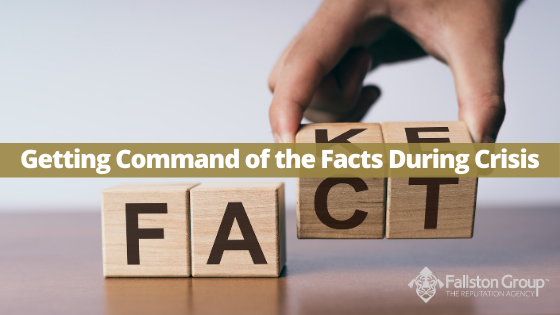
By Rob Weinhold, Fallston Group Chief Executive You may have heard me say in the course of our discussions on past occasions: during times of crisis, we must first get command of the facts. In my opinion, that statement rings especially true right now. It’s safe to say we are all in “information overload mode,” as the COVID-19 story continues to evolve and be told in a hundred (or more) different ways. Differentiating between what is true, what is partially true, what is false, and what is an opinion presented as a fact, can become seriously challenging. Credit is due to Maryland Governor Larry Hogan and his team for their attempt to set the facts straight once and for all, and educate the public to the best of their ability. In case you haven’t already seen it, the State has launched a new page on its web site focused on “Rumor Control.” Here is the link. It gives Marylanders a source for the truth, outlining government orders, organized by category, to provide clarity and minimize confusion. There is also a button on the right-hand side of the page that asks viewers to “submit a rumor.” If you are questioning if something you are hearing is true, the government wants to hear about it and is committing to addressing it. That’s what I call good leadership. I also believe it’s a model we can all learn from. Let me be clear, this is not a politically-based comment, rather a sound leadership observation. This pandemic should never be about politics, rather public health. Saving lives matter and we all play a part. What kinds of similar open communication forums could you implement within your own businesses to keep your people accurately informed? I encourage you to think of tools that will help today, not just in the midst of this global health pandemic, but those that will also be applicable once this is all over. Need help brainstorming ideas or coming up with a strategy for open internal communications? Reach out to your friends at the Fallston Group. That is what we are here for.
Coming Together During Times of Adversity
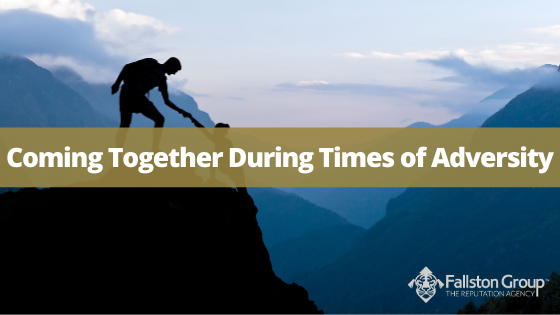
More than 150,000 people across the U.S. have been diagnosed with the coronavirus. That’s more cases than any other country. The national death toll is 2,870, and rising by the hour. The numbers are just as frightening at the local level, with 1,413 diagnoses and 20 deaths reported in the state of Maryland. The impact on society, the economy, and human life as we know it is crippling, too. The number of people out of a job and consequently applying for unemployment is topping out at more than three million. Some school systems have already announced they will remain closed for the remainder of the academic years; others have extended their closure periods, causing parents of high school seniors to wonder if they will even get to see their kids walk across a stage and graduate. The 2020 Tokyo Olympics are postponed. The NBA, NHL, and MLB are shut down. Walt Disney World is closed until further notice. And the stock market? If you are invested in it, you are probably spending time every day analyzing trends and trying to decide what to do and how much risk to take. Yes, it’s a time of great turmoil, a time of great fear, and unfortunately, a time of great loss. However, it can also be a time of great unity. Locally, many people are heeding to Maryland Governor Larry Hogan’s orders to remain at home as much as possible and practice social distancing when we must venture out. But something very interesting is happening during this time of “slowed pace.” Families are going for long walks and sitting down together for daily meals. The “daily grind” has but put on “pause” and suddenly, there are enough hours in the day. More and more people are also demonstrating acts of kindness to care for their community. There seems to be a gentle and genuine understanding that we are all in this together, and that humanity is one thing that can help us through. Now let’s apply that same principle to the business world. The Fallston Group was founded ten years ago with a primary goal to help companies plan for and manage times of adversity. Like many, we are working hard every day to manage this crisis, but we are also here to be a resource for you. We believe now is the time for business owners to come together, support one another, offer ideas and solutions, and perhaps most importantly, encouragement. Stay tuned for our next blog, which will be posted later this week and will offer some strategies and recommendations for business owners on the process of recovering from crisis.
Effective Communication in the Midst of Crisis

At this point, it’s safe to assume that every business across America has been impacted by COVID-19. As your team is navigating this crisis and implementing strategies to best manage it, the value and importance of internal communications strategy is KEY. Keeping those communication lines open is so very important – more so now than probably ever before. At the same time, bear in mind that everyone is working through unusual, unfamiliar circumstances. Those who typically see 100 emails per day in their inboxes might be seeing double that or more. That said, equally important at this juncture is prioritization of internal information exchanges. Streamlining communication processes will help your team to operate as efficiently as possible during this critical time. At Fallston Group, we recommend implementing the following general internal communication protocols and guidelines within your business: Communicate with purpose. Send updates only when they contain new or time-sensitive information, or answers that the team is relying on and needs NOW. Be selective in who receives your messages. Think strategically about the message you are sending and who really needs to see it. Include only those individuals on your distribution list. Halt the automatic “reply to all.” Everyone who received a message might need that message. Chances are, not every person on the list needs to receive every reply, in turn. Consider this as you craft your reply and right before you hit the “send” button. Keep it brief. Whenever possible, send emails that are concise and easily digestible – a “quick read” approach, per say. At a time when everyone is overloaded with critical priorities, it’s more likely that a quick paragraph will be read than a message that is a full page long. Cover more than one topic in a single email, whenever possible. Brevity is key and it is more efficient to send one email that conveys priority information on 2-3 topics rather than a separate email per topic. Save the message for the next meeting, if possible. Before you craft a message and hit the “send” button, pause and ask yourself if the information MUST be transmitted via email, at that moment, or if it can instead be communicated at the next team meeting. If it can wait, hold it. Assume everyone is grateful. By nature, if someone sends us an email, we are inclined to hit the reply button to thank them for the information they have provided. At this point, we can assume everyone is working hard is grateful for the collective effort. We can cut down on email overload significantly by eliminating replies of “thanks” or “got it.” We encourage you to adopt and share these protocols and guidelines throughout your organization, so that we can all work as efficiently as possible in the coming days, weeks, and months. Stay safe. Stay well.
The Public Face of Crisis

By Rob Weinhold; as originally published in Sheriff & Deputy Magazine When a crisis engulfs your office, you will appear in front of a bank of microphones, and—with white-hot TV lights glaring and cameras rolling—stare out into a sea of skeptical media faces and attempt to deliver a timely, coherent response on behalf of your organization. And with each community meeting, speech, or media interview, you will either make a small deposit into, or a heavy withdrawal from, your reputational “piggy bank”—whose balance you hope never reaches zero. I have learned from many incredible communicators who perform spectacularly under duress. It is an art, not a science. As with wine, one gets better with age; there is no substitute for experience. The best communicators I know are obsessive about every syllable they utter, every piece of clothing they wear, and every message point they deliver. They call each reporter back, treat them fairly, and never compromise their integrity; they understand what reporters need and make themselves relevant to those who have editorial control. The best communicators also learn how to steer clear of organiza- tional jargon, are detail-oriented, and deliver news compassionately in a conversational manner that connects with those who consume their words emotionally. They are analytical, well-timed, and process loads of information almost instantaneously. And they are never too high or too low; they have a steady hand under pressure, no matter the gravity of the situation or the tightness of the deadline. In the event they run into an aggressive reporter, they can manage the situation with the grace and humility of a 10th-level verbal judo artist. If they had the God-given talent to perform on the gridiron, they’d run two-minute drills with the game on the line. And like Peyton Manning, the best are prepared, informed, and always find a way to hone their craft. You want them on your team, because they understand the big picture and see the whole room. It’s what they do best. Read more in Rob Weinhold’s recent article published in Sheriff & Deputy Magazine via the National Sheriff’s Association, and learn more about Fallston Group’s crisis & issue leadership services, including media training workshops, to help prepare your business.
