

Crisis Chat: Courage to Confront

The Power of Crisis Leadership (Part Three)

The following is the last of three excerpts from a feature article, written by Rob Weinhold, Fallston Group Chief Executive, and published by “Captive International” in July 2020. Read part one here and part two here. Looking for ways to ensure your reputational piggy bank continues to overflow? Fallston Group offers the following guidance, based on our most powerful lessons learned over the past decade of helping clients through events of adversity: Never erode your integrity: misinformation breeds distrust. There can be an immense pressure to “make your organization look good.” Many want you to press your nose up against the ethical window of truth and transparency. Do not cave in to others who would like you to lie, distort the truth or leave vital facts behind which alter messaging and perception—this is tantamount to a lie. Once it’s lost, you will never fully restore your integrity. Be relevant: as the art of traditional and digital press relations evolves within a changing worldwide media landscape, many leaders seem less inclined to return a reporter’s calls, or otherwise seek to delay the release of information. Some view this as refusing to feed the “media monster”. By sticking their heads in the sand and not responding, businesses make themselves irrelevant and ineffective. If you don’t tell your story, someone else will. When someone else tells your story, it certainly won’t be the story you want told. Know the facts: a common mistake of many who speak publicly revolves around not fully preparing and gaining a sound understanding of the facts before articulating their position. Too many professionals jump out on camera or in front of an audience with no substantive information or an unwillingness to engage with questions. Not knowing the facts or relying on the “no comment” phrase is unacceptable. Know your position, know your craft: it’s your legacy. Be predictive: when preparing to deliver a message, be certain to plan for every question and eventuality. There is often a tendency for people to want to go on camera without fully preparing because they are used to speaking publicly or know the organization very well—chief executives are good for this. Push back and demand ample preparation. Failing to plan is planning to fail. An eight to 15-second media soundbite can ruin your career—just ask BP’s former chief executive, Tony Hayward, who recklessly uttered “I want my life back” after one of the world’s most damaging oil spills that killed 11 people in 2010. Don’t wing it; prepare for every interview no matter how mundane or harmless it may seem. Build media relationships: know those who tell your story—media and your ambassadors—as well as your detractors. You want to get the benefit of the doubt when people tell your story. It’s not about an unfair advantage, but simply balance. When managing the media, gather intelligence from reporters and news organizations—ask them what angle they plan to cover, who they are speaking with and what their position is. They are under no obligation to share these details, but you’d be amazed at what they will tell you, particularly if there is an existing relationship or future mutual need. Video doesn’t tell the whole story: a video account of what happened does not factor many variables—what each party said, body language from all angles and what transpired before and after the footage. In today’s digital world, everyone is a citizen journalist with an opinion, and many want to be the next YouTube sensation. More is recorded and shared than at any other point in history. The emergence of video has changed all professions, but be careful when making a judgement or decision based solely on video evidence. Treat video for what it is: another tool in the search for the truth. Practice, practice, practice: it is essential to practice public speaking. Practice on camera in an authentic, safe environment. Reputations on camera can save your career. Seek advice from colleagues. take a look at how others have responded during times of crisis and leverage their lessons learned to your advantage. Your colleagues, peers and competitors are invaluable pools of knowledge and can serve as the single most important case study resource. Be a student of your peer experiences and learn from other’s successes and missteps. Of the many leaders I’ve worked with during crises, there are two benchmarks of success which allow leaders to quickly maintain control and weather the storm. First, they put their hand in the air and recognize they are in trouble—they don’t let their ego get in the way. Second, they ask for help from their trusted circle. Recognition of trouble and decisiveness in action will help you turn short-term adversity into long-term advantage.
Getting Command of the Facts During Criss
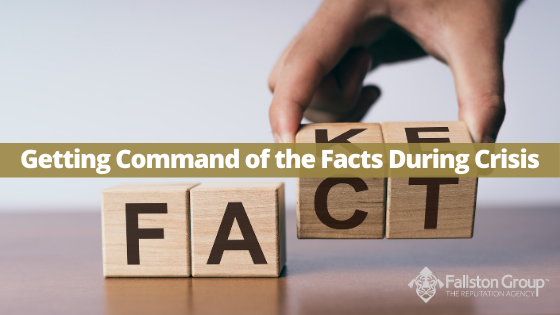
By Rob Weinhold, Fallston Group Chief Executive You may have heard me say in the course of our discussions on past occasions: during times of crisis, we must first get command of the facts. In my opinion, that statement rings especially true right now. It’s safe to say we are all in “information overload mode,” as the COVID-19 story continues to evolve and be told in a hundred (or more) different ways. Differentiating between what is true, what is partially true, what is false, and what is an opinion presented as a fact, can become seriously challenging. Credit is due to Maryland Governor Larry Hogan and his team for their attempt to set the facts straight once and for all, and educate the public to the best of their ability. In case you haven’t already seen it, the State has launched a new page on its web site focused on “Rumor Control.” Here is the link. It gives Marylanders a source for the truth, outlining government orders, organized by category, to provide clarity and minimize confusion. There is also a button on the right-hand side of the page that asks viewers to “submit a rumor.” If you are questioning if something you are hearing is true, the government wants to hear about it and is committing to addressing it. That’s what I call good leadership. I also believe it’s a model we can all learn from. Let me be clear, this is not a politically-based comment, rather a sound leadership observation. This pandemic should never be about politics, rather public health. Saving lives matter and we all play a part. What kinds of similar open communication forums could you implement within your own businesses to keep your people accurately informed? I encourage you to think of tools that will help today, not just in the midst of this global health pandemic, but those that will also be applicable once this is all over. Need help brainstorming ideas or coming up with a strategy for open internal communications? Reach out to your friends at the Fallston Group. That is what we are here for.
Effective Communication in the Midst of Crisis

At this point, it’s safe to assume that every business across America has been impacted by COVID-19. As your team is navigating this crisis and implementing strategies to best manage it, the value and importance of internal communications strategy is KEY. Keeping those communication lines open is so very important – more so now than probably ever before. At the same time, bear in mind that everyone is working through unusual, unfamiliar circumstances. Those who typically see 100 emails per day in their inboxes might be seeing double that or more. That said, equally important at this juncture is prioritization of internal information exchanges. Streamlining communication processes will help your team to operate as efficiently as possible during this critical time. At Fallston Group, we recommend implementing the following general internal communication protocols and guidelines within your business: Communicate with purpose. Send updates only when they contain new or time-sensitive information, or answers that the team is relying on and needs NOW. Be selective in who receives your messages. Think strategically about the message you are sending and who really needs to see it. Include only those individuals on your distribution list. Halt the automatic “reply to all.” Everyone who received a message might need that message. Chances are, not every person on the list needs to receive every reply, in turn. Consider this as you craft your reply and right before you hit the “send” button. Keep it brief. Whenever possible, send emails that are concise and easily digestible – a “quick read” approach, per say. At a time when everyone is overloaded with critical priorities, it’s more likely that a quick paragraph will be read than a message that is a full page long. Cover more than one topic in a single email, whenever possible. Brevity is key and it is more efficient to send one email that conveys priority information on 2-3 topics rather than a separate email per topic. Save the message for the next meeting, if possible. Before you craft a message and hit the “send” button, pause and ask yourself if the information MUST be transmitted via email, at that moment, or if it can instead be communicated at the next team meeting. If it can wait, hold it. Assume everyone is grateful. By nature, if someone sends us an email, we are inclined to hit the reply button to thank them for the information they have provided. At this point, we can assume everyone is working hard is grateful for the collective effort. We can cut down on email overload significantly by eliminating replies of “thanks” or “got it.” We encourage you to adopt and share these protocols and guidelines throughout your organization, so that we can all work as efficiently as possible in the coming days, weeks, and months. Stay safe. Stay well.
Top Ten Tips After Navigating Ten Years of Crisis

Fallston Group, the Baltimore-based, global reputation agency, is celebrating its tenth year of building, strengthening and defending reputations. Outside of highlighting the basics – operating with integrity, taking responsibility and being decisive – chief executive Rob Weinhold offers his top 10, in-depth pieces of advice to successfully manage a crisis based on decades of experience helping people during their most difficult times: Be predictive. Organizations must be predictive and create organizational muscle memory through extensive assessment, policy development and training. Organizations who evaluate their company-based and industry threats cycle through crisis more quickly and are bigger, faster, stronger after their defining moment. Tell your story. If you don’t tell your story, someone else will. And, if someone else tells your story, it certainly won’t be the story you want told. A crisis rarely “goes away” – be transparent and get in front of the media and general public versus refusing to comment. The ability to tell your story is your most important growth strategy. Find the points of leverage. Understanding what motivates all parties involved in crisis will drive outcomes, and a win-win, if possible. This sounds simple, but it’s not. There are always points of leverage in an adversarial situation – find them and focus. Know what motivates people who behave badly. The five core primal drivers I’ve observed include power, control, money, sex and revenge. Be wary of people who are strictly motivated by one or more of these drivers. Or, use it to your advantage. Reframe your public remarks, if misunderstood. Every single person I know has at some point misspoken or has not articulated a point in an optimal manner – reframe vs. denying, debating or being offended. Remember, the general public, not a reporter, is the ultimate consumer of the information you are attempting to convey. Above all else, the most important message is the message received. Admit you are in crisis and connect to your trusted advisors. Most people don’t want to admit they are in crisis and steadily losing control – do this quickly as your window of opportunity will close quickly. Whether your personal obstacle is ego, complacency, embarrassment or uncertainty, get over it. Admit you are in need and seek the opinion of those you trust. Remember: tired + wired = fired! Spread the pain to those who are cerebral, not emotional. Command the facts. Too many times professionals make rash decisions and jump out on camera with either no substantive information or rely solely on the “I can’t comment on that” or “I don’t have that information” phraseology. Bottom line: if you decide to publicly address a crisis, have something important to say – and maintain a strong command of the facts. Remove the opportunists. I’ve seen it over and over again. When a leader is in trouble or wobbling due to crisis, there are very few who maintain a strong sense of loyalty to the one they serve while many others remain silent or work covertly to push the leader out the door, hoping they can sit in the big chair one day soon. When you are embroiled in crisis, it can be a very lonely, thankless road – you become a perceived liability to others who are not willing to embrace the risk, even though you may be 100% right. The DNA of the opportunist is such that their loyalty is stalwart as long as it is politically expedient to do so and ultimately advantages them and their careers. These are the wolves in sheep’s clothing. Find out who the wolves are and remove them – they are only there to facilitate your demise. Be direct. There is a tendency to soften words or not be direct with ominous news. While initially shocking, people prefer the bottom line right away. I call this bad habit “circling the messaging runway” vs. “landing the plane.” Do not circle the runway with negative or emergent news; immediately tell people what is going on. You will earn their confidence and trust more quickly. Have faith in a higher being or larger purpose. When a person is on the brink of or embroiled in crisis, keenly focusing on taking care of one’s mind, body and spirit is critically important. Spirit, in particular, becomes even more essential when people feel they’ve lost control of a situation. I’ve worked with many troubled leaders where their renewed sense of spirituality, or belief in a larger purpose, helped them navigate their storm. To learn more about Fallston Group’s anniversary and services, visit www.fallstongroup.com/anniversary.
The Lasting Effects of Shots Fired

By Leah Fertig Active and mass shooting events have been filling our news feeds recently both nationally, such as the New Zealand shooting at two mosques on March 15, and locally, including the most recent school shooting at Frederick Douglas High School in Baltimore, MD on February 8. According to published crime statistics, there were 340 mass shooting incidents in our nation last year; a total of 373 people were killed and 1,347 were injured. One would like to think that once the shock of the tragedy is over and loved ones are laid to rest or those injured are released from hospitals that the effects of mass shootings end there. Sadly, that’s not the case; there are long-lasting, negative emotional effects that continue for weeks, months and lifetimes. When it comes to mass shootings, it’s important to realize it’s not only those directly connected to a tragedy who feel the long-lasting effects. For example, the Frederick Douglas High School shooting in Baltimore did not only affect the victim who was injured, but also the entire student body and the institution’s staff, faculty and administrators. Trauma comes in many forms and is unique to each individual and how they, and their families, cope. The National Center for PTSD explains there are four phases following mass violence: Impact, Rescue, Recovery and Reconstruction (Long-Term). They state, “While the majority of affected individuals will see a lessening of distress over time in the long-term phase, vulnerable populations such as those with injury, severe disaster exposure or ongoing adversities, may continue to suffer for years after a large-scale disaster or mass violence event.” This March, we lost 3 lives to suicide that were all connected to school massacres and post-traumatic stress. Some may wear their pain on their sleeves while others may bottle it up and outwardly project that they’re not struggling inside – a struggle that has the potential to evolve into a future tragedy. There seems to be no limit to the location in which an active-shooter tragedy can occur; they happen in places we should feel the safest, such as places of worship, malls, movie theaters, concerts and schools. It is imperative for businesses and institutions to understand that although not all crises can be prevented, you can certainly prepare for those worst-case scenarios, such as an active shooter. Have you done all you can to protect your people, secure your assets and strengthen your brand? Call or email today to start building the organizational muscle memory you need to give employees the tools and confidence to survive a very high stress, sudden and volatile event. There is no question, lockdowns save lives; you must be prepared as the first order of leadership is to provide a safe place to live, work and raise a family.
Top Business Reputation Tips
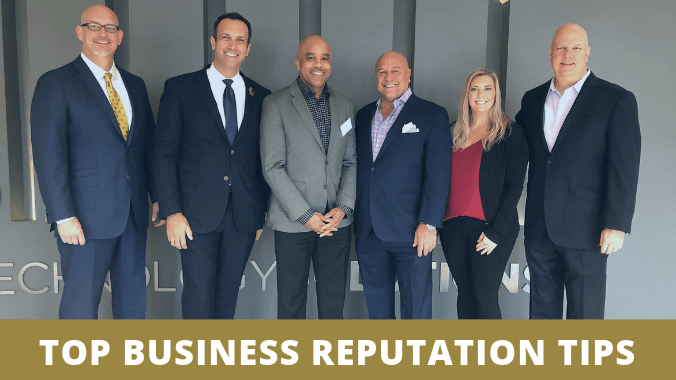
Whether or not you had the chance to attend our most recent Business Reputation Panel in person, every leader can benefit from our expert panelists’ top tips to preserve and protect your company’s reputation. James “Jef” Fagan, Principal Attorney at Offit Kurman advises businesses to not only pick a primary spokesperson – but to make certain your employees know who that spokesperson is. Legally, employees need to understand if the media calls, they should not answer any questions. If a crisis occurs, employees should be given a script for answering the phone, and direct callers to the primary spokesperson. Scott Canuel, Executive Director and Market Team Lead at J.P. Morgan explains employees must know what to expect in terms of protocol BEFORE a crisis occurs. Employees should be updated on your company’s crisis plan on a regular basis, and training must be consistent. (Fallston Group tip: this establishes organizational muscle memory and reduces stress when a crisis does occur!). Rachael Lighty, Public Relations Manager for Amazon Operations stresses that “your reputation is not a shot in time.” Your reputation must be worked on alongside your relationships with your customers and trusted advisors every single day. Think about your reputation during your everyday business decisions – it is an active ongoing process. Kai Jackson, Co-anchor at WBFF-TV Fox45 News tells us from the media’s perspective, “please know I have a job to do just like you do.” When a crisis occurs, it is extremely helpful for your company to have a point person to go to for information who can speak MEANINGFULLY about the issue. The media’s job is to report professionally and respectfully. The more substance your business can provide, the better the media will be able to represent your story. Ed Norris, radio personality and actor gives personal advice from the heart: build your relationships TODAY. And not just with your company and board’s executives, but with all of your employees. Every person matters. These relationships will benefit you in the long-term, and those people will have your back not if, but when things go sideways. Rob Weinhold, chief executive at Fallston Group, urges leaders to understand reputation leads to trust, and trust leads to valuation. And, not all currency is financial. Your reputational equity must be built BEFORE crisis strikes; your business must always be ready to make a withdrawal from your reputational piggy bank. For more information about crisis leadership strategies, how to understand your risk and how to better prepare for a crisis, contact Fallston Group at info@fallstongroup.com, call 410.420.2001 or visit our website.
Crisis Expert Rob Weinhold Launches National Keynote

Rob Weinhold, author and chief executive of Fallston Group, the Baltimore-based, global reputation agency, today announced a new national keynote speaking campaign, “Crisis is a Growth Strategy,” including the launch of Weinhold’s brand-new website, robweinhold.com. Over time, Weinhold has been relied upon to lead, manage, coach, teach, interview, keynote, conduct workshops and train a variety of organizations and individuals in the field of crisis leadership. After working with so many clients, his “crisis is a growth strategy” approach has not only driven dramatic results, it is the reason many engage. This is why Weinhold developed his new keynote presentation and workshop. In today’s turbulent world, the issue isn’t if crisis will occur, but when. Weinhold addresses how to prepare for, navigate through and recover from sensitivity, adversity and crisis. Through proper crisis leadership tactics, Weinhold teaches the importance of turning short-term adversity into long-term advantage. “Reputation leads to trust, and trust leads to valuation,” explains Weinhold. “By successfully leading an organization through life’s most difficult times, one can not only positively impact a company’s reputation, the organization will emerge bigger, faster, stronger than it was before that defining moment. Ultimately, more value is created.” Throughout his career, Weinhold has been recognized for his unique ability to lead by creating vision and building consensus across diverse stakeholder bases, even during the most sensitive of times. He is routinely called upon by members of the national and local news media to provide perspective on crisis leadership, public safety and strategic communications. After several decades of private and public sector leadership service, Weinhold launched Fallston Group nearly a decade ago to build, strengthen and defend reputations. “Rob is a captivating speaker who genuinely connects with his audience through practicality and humanness,” says Ragina Cooper Averella, Public and Government Affairs Manager for AAA Mid-Atlantic. “For a living, Rob helps leaders snatch victory from the jaws of defeat. His experience and instinct is simply invaluable.” Weinhold was recently elected to the Johns Hopkins Carey Business School’s Dean’s Advisory Council to support the School’s pursuit of innovation in business knowledge and learning while educating business leaders as citizens. Weinhold was also recognized as a 2017 Most Admired CEO by The Daily Record. He holds a graduate degree (MSM) from The Johns Hopkins University Carey School of Business and undergraduate degree from the University of Baltimore. A nationally published author, Weinhold’s book (The Art of Crisis Leadership, 2016) skyrocketed to become a #1 new release in Amazon’s PR and Crisis Management categories and top 100 in Leadership. He has also trained and lectured in many professional and academic settings. For additional information about Weinhold, to schedule an interview or book a workshop, contact Fallston Group’s Marketing Communications Manager Andrea Lynn at 410.420.2001 or by email at andrea.lynn@fallstongroup.com.
Crisis Strikes: Who to Call

What’s the “Why” Behind a Crisis?
Many crises are sustained campaigns, not situational media events. In my view, reputation leads to trust and trust leads to valuation. You see, snatching victory from the jaws of defeat is all about the restoration of trust and restoring that reputational piggy bank balance which succumbed to overdraft status. We know crises can be natural, like an earthquake, or human-induced, like an egregious crime or gross mismanagement. Crises can be sudden or smoldering, high-impact or low-impact. Sometimes organizations recover. Many times, they do not. Crises can take on many forms: data breach, social media attack, negative press, natural disaster, bankruptcy, crime, litigation, investigation, compliance issues, employee relations complications, job loss, labor unrest, audit sanction, poorly managed mergers, workplace violence, terrorism, war, riots, accidents, health issues, product recall, hostile takeovers, abuse, ineffective leadership transition, and discrimination—to name some of the prominent. Life is a complex struggle at times, with a seemingly high level of unpredictability. But one thing is certain: crisis will strike. It’s not a matter of if. It’s a matter of when. In recent years alone, many high profile leaders have faced serious reputational issues that have cost them tremendous amounts of time, money, customers and, ultimately, their careers – generally in that order. And, in the worst case of scenarios, lives. In my decades of managing crisis—the overwhelming number which are human induced—I’ve found premeditated crises are deeply rooted in the issues of power, control, money, sex and revenge. Yes, these are the core motivating factors of why people do bad things. Some are driven by a singular vice, others are firing on many motivating cylinders. As wonderful as the human spirit is, there is often another side to some of us, a side in which these dark, addictive triggers become more important than life itself. And sadly, it’s generally those who orbit the lives of those in crisis—and depend on the afflicted people or organizations emotionally, financially or spiritually—who suffer the most when crisis unravels. Life lesson for today – closely evaluate who you have in your ecosystem, personally and professionally. Are the people you inherently trust with your business or reputation motivated by any of the core factors outlined above? Are they really making the right decisions for you, your business, your brand? Take a hard look at “why” these people make the decisions, or act, the way they do. You just may find that YOU need to make some tough eliminating choices as you work your way toward a more brilliant and prosperous future. To learn more about building, strengthening and defending your company’s reputation, please contact us directly at Fallston Group, or call 410-420-2001.
